
The Economy As It Is, Or The Economy As It "Should Be"
By Tyler Durden
Submitted by Jeffrey Snider via Alhambra Investment Partners,
The mainstream view of the unemployment statistics suggest that any weakness in the US economy, manufacturing or beyond, will be temporary and shallow because employment growth remains robust. The question is not whether the statistics suggest such a trend but rather if those accounts correspond with anything real. As noted earlier this week, even the Federal Reserve’s relatively new measure of broader employment conditions has registered a clear deviation due to economic weakness that amplified toward the end of 2014.
At the very least, there is enormous pressure in the energy sector. It is being felt as a double shot from oil prices affecting direct business and now an almost certain turn in the credit cycle that will shut off additional liquidity just when weaker firms need it the most. The latest quarterly update from oil services giant Schlumberger is all that is necessary to understand the economic “headwind” coming from the energy space:
“The decline in global activity and the rate of activity disruption reached unprecedented levels as the industry displayed clear signs of operating in a full-scale cash crisis,” Chairman and Chief Executive Officer Paal Kibsgaard said in an earnings report Thursday. “This environment is expected to continue deteriorating over the coming quarter given the magnitude and erratic nature of the disruptions in activity.”
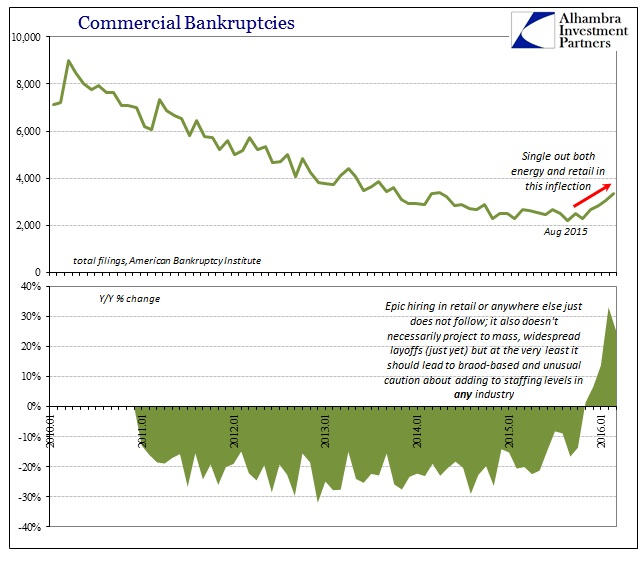
No cash and no prospects for achieving more junk flotations mean only more of the worst case – bankruptcies and, for the junk bubble, defaults. The significance of the oil industry is more than just its epic fall from flush and grace; it represents the first segment that has already passed through the economic boundary and there are already a number of other sectors ready to follow into the amplified downdraft. This morning I found that it is both oil and retail that is leading the current turn in bankruptcies already.
The jump in commercial bankruptcies and the timing of it corresponds quite well to what we find in actual consumer spending, especially activity in goods or just retail sales. It does not correlate at all with what the BLS is projecting about hiring and employment in the retail sector. Even if retail pressure is only just beginning, the last trend you would expect to find is sustained hiring at a truly historic rate. Since this downturn in activity is not just a sudden one or two month appearance, it is far more sensible to assume that retailers would have been cautious about staffing far a long time already.
Again, the inflection in commercial bankruptcies, especially retail firms, and the notable and sustained dropoff in retail sales makes sense; the BLS’s calculated strength in hiring in retail and the whole economy does not.
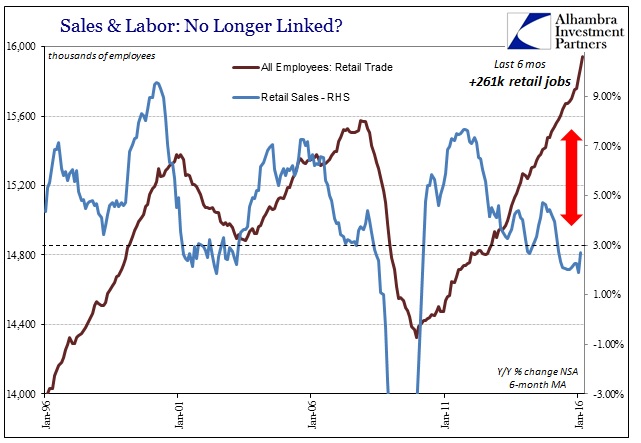
It also cuts against the idea that this is some temporary problem even though temporary (or transitory) now stretches toward a third year. Some of the current …read more
Source: The Economy As It Is, Or The Economy As It "Should Be"


