
Why Don’t The Dollar And Bitcoin Drop To Their Tangible Value (Zero)?
By Tyler Durden
Submitted by Charles Hugh-Smith via OfTwoMinds blog,
If we refuse to recognize the high utility value of USD and its global ease of flow, then we will continue to misunderstand the demand for the dollar and its appreciation.
I have covered the many reasons why the U.S. dollar (USD) has strengthened in dozens of posts over the past 5 years, (Could the U.S. Dollar Rise 50%?, January 12, 2011), and I described the positive dynamics of bitcoin last summer in An Everyman's Guide to Understanding Cryptocurrencies (June 13, 2016), back when bitcoin was under $600.
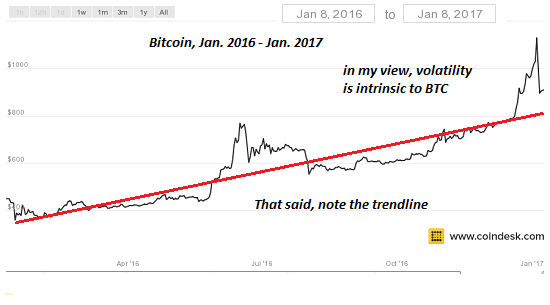
The USD (as measured by the US Dollar Index) has gained almost 40% from 73 in 2011 to 102 recently, and bitcoin recently topped $1,000 (trading at $909 as this article goes to print).
These gains aren’t trivial, nor are they magic. They are the result of basic economic forces: supply and demand, utility, liquidity, capital flows and risk management.
Capital migrates to where it flows with the least resistance, i.e. to forms of capital that are liquid and offer low transaction costs—what I call ease of flow. Capital also migrates to relatively safe havens that are liquid and offer low transaction/holding costs, and to forms of capital with global utility.
Lastly, capital flows to the highest yield/return with the lowest perceived risk.
Given these fundamentals, it isn’t difficult to understand why capital is flowing into USD-denominated assets and bitcoin.
So what do the fundamentals suggest about the valuation uptrends in the USD and bitcoin? Have they topped out and due for a crash, or have they just started their appreciation cycle?
To formulate a coherent answer, we need to consider two things:
1. The foundations of their value
2. The inability of central states and banks to control their currencies and their place in the global economy.
Why Don’t the U.S. Dollar and Bitcoin Have Zero Value?
There’s a fair amount of confusion about why currencies (or in the case of bitcoin, digital commodities that share the utility functions of currencies) that are unbacked by tangible assets such as gold don’t just drop to their tangible value, i.e. zero.
After all, most USD are just digital entries and the rest are just paper. Bitcoin is also just a digital construct with no intrinsic value.
The answer boils down to utility-driven demand. If, as David Graeber discussed in his book Debt: The First 5,000 Years, notched sticks are needed to pay one’s taxes, then notched sticks are in demand because they have an essential utility; notched sticks acquire value (i.e. become “money”) if you can pay debts (such as taxes) with them.
As long as they retain this utility, they retain the value ascribed to them by the system that recognizes (or demands) payment of taxes in the form of notched sticks.
A notched stick has near-zero tangible value. Its value is entirely a social construct, as a placeholder for the goods and services produced by labor and capital.
It frustrates many observers that the U.S. dollar stubbornly refuses to drop to its intrinsic value, …read more
Source: Why Don’t The Dollar And Bitcoin Drop To Their Tangible Value (Zero)?


