‘Rogue One’ – Huge box office win

“Rogue One: A Star Wars” opens to big box office expectations this weekend for Disney …read more
Source: ‘Rogue One’ – Huge box office win


“Rogue One: A Star Wars” opens to big box office expectations this weekend for Disney …read more
Source: ‘Rogue One’ – Huge box office win
By Tyler Durden

Submitted by Allan Flynn via ComexWeHaveAProblem blog,
As it goes in silver, so it goes in gold. In London at least.
In a bid to have UBS reinstated as a defendant in a London Gold Fix antitrust lawsuit, plaintiffs documents submitted to a New York Court last week include explosive chat room transcripts of UBS and traders from different banks encouraging each other to “push,” “smack,” and “whack” gold prices.
The transcripts are equally as startling as those described of banks of the London Silver Fix and UBS given to the court the previous day and described last week in this article.
On December 6th attorneys for plaintiffs in a consolidated class action against banks of the London Gold Fix and UBS, asked the court for leave to amend with a Third Amended Complaint. The TAC includes additional facts based on a “limited set of cooperation materials” produced by former defendant Deutsche Bank, as part of a settlement agreement and further statistical analysis.
Supporting documents say the amended complaint addresses the Court’s October finding that the previous complaint failed to plausibly plead firstly that UBS was part of the antitrust conspiracy, and secondly that the conspiracy existed prior to 2006.
Also, for the first time a gold producer has been added to the class action of those claiming losses in gold trading due to the manipulation. Compania Minera Dayton, SCM the Chilean subsidiary of Australian resources company Lachlan Star is said to have “sold gold on many of the specific days on which Plaintiffs demonstrated manipulation of gold investments” totaling $287.4 million over the period 2004 to 2013.
In support of allegations that UBS shared customer order information and executed coordinated trades to manipulate gold markets, samples of “dozens” of chat room messages between UBS and Deutsche Bank are contained in the revised document indicating “many efforts to artificially suppress gold prices, and to manipulate gold prices at the time of the Fixing.”
Filings include the following script reminiscent of an 1980’s arcade game scene. Rather than competing for business in the marketplace, supposed competitors UBS and Deutsche Bank however are seen coordinating tactics as they anticipate the most illiquid of days to jointly execute their sell orders for greatest negative impact on the market.
Deutsche Bank: bro japan holiday today
Deutsche Bank: think it’ll be quiet
Deutsche Bank: well, illiquid, not quiet haha
Deutsche Bank: illiquid means wild wild west
UBS:okay when gold pops 1430
UBS: we whack it
UBS: u sell your 50k
UBS: i sell my 20k
UBS: then we double that up and produce our on liquidity too
UBS: that should be enough to cap it on a holiday
Deutsche Bank: haha yeah
Deutsche Bank: lol
One chat see's a Deutsche Bank trader confirming with a UBS trader his trading had indeed influenced the Gold Fix: “u just said u sold on fix.” The UBS traded replied “yeah,” “we smashed it good.”
The secret associations between traders appear to be close knit, with the members willing …read more
Source: "When Gold Goes Above 1430 We Whack It"
By Tyler Durden

Update: moments after the original post, Trump has corrected his spelling error in a follow up tweet which, correctly, accuses China of engaging in an “unprecedented act” by seizing the US naval drone.
China steals United States Navy research drone in international waters – rips it out of water and takes it to China in unprecedented act.
— Donald J. Trump (@realDonaldTrump) December 17, 2016
Irrelevant spelling mistakes aside, China’s drone seizure is likely a signal to President-elect Donald Trump that it won’t take his phone call with Taiwan lightly, an expert said on Friday. “Knowing Chinese military officials for many years and how orders are communicated from the highest power centers in Beijing down to commanders on the ground or water, this was very likely a highly planned and escalatory move to show China will not take matters lightly when it comes to President-elect Trump’s phone call and comments on Taiwan, or Chinese actions overall,” said Harry Kazianis, director of defense studies at the Center for the National Interest.
The ball is now in Trump’s court if he wishes to further escalate.
* * *
Following yesterday’s biggest, market-moving geopolitical event, in which a US oceanographic vessel had its underwater drone “stolen” by a Chinese warship “literally right in front of the eyes of the American crew”, we predicted that everyone would be eagerly waiting for Trump to chime in on the topic, and further escalating the diplomatic spat between the two nations which now involves China confiscating US marine drones, the first of its kind seizure in recent history:
everyone F5ing the @realDonaldTrump page
— zerohedge (@zerohedge) December 16, 2016
21 hours later, it finally happened, when the President-elect used his favorite social media outlet to Tweet that “China steals United States Navy research drone in international waters – rips it out of water and takes it to China”, an act which he called “unpresidented.“
… and as a result, the social media response has been more focused on Trump’s spelling, than his outrage:
I know it’s trivial & probably helps Trump when people hype things like this, but it’s genuinely shocking he thinks it’s spelled this way pic.twitter.com/Mkw0J4Fqfd
— Glenn Greenwald (@ggreenwald) December 17, 2016
Still, as tensions runs high between the two superpowers, and as some wonder if Trump will do anything else in retaliation besides being confined by Twitter, China’s act confined merely there was some signs of de-escalation, after China said on Saturday that Beijing and the US are using military channels to “appropriately handle” the seizure by the Chinese navy of a U.S. underwater drone in the South China Sea, and a Chinese state-run newspaper said it expected a smooth resolution. The drone was taken on Thursday, the first seizure of its kind in recent memory, about 50 nautical miles northwest of Subic Bay off the Philippines, just as the USNS Bowditch was about to retrieve the unmanned underwater vehicle (UUV), U.S. officials said.
“It is understood that China and the …read more
Source: Trump Slams Chinese Seizure Of US Drone, Calls It "Unprecedented Act"
By Tyler Durden

Submitted by Duane via Free Market Shooter blog,
On Thursday, December 1st, Yasmin Seweid was allegedly assaulted by Trump supporters in NYC. According to BuzzFeed and the NY Daily News, the attack took place at the uptown 6 train stop at 23rd Street in midtown Manhattan. The assaliants allegedly called Seweid a terrorist, broke her bag strap, followed her when she tried to get away from them, and tried but were unable to pull her hijab off of her head.
Both Tamerra Griffin and Ben Kochman, the authors for BuzzFeed and the NYDN stories, did not include any additional sources for their story, other than Seweid’s personal account and a statement from police that the “investigation was ongoing” with no further comment. It seems both read her Facebook post recounting her story (which has since been removed), and after speaking with her, they took it and her account of the incident as fact, without verifying her story anywhere else. Even though Seweid was their sole source for the story, they didn’t even bother to include the word “allegedly” as I did in italics above. The NY Daily News said Seweid stated the following:
They kept screaming Trump’s name at her, and then said, “Oh look, a (expletive) terrorist,” she said.“ Get the hell out of the country!” they yelled during the train ride. “You don’t belong here!”
When Seweid ignored them, they pulled on her bag to get her attention and the strap broke.“That’s when I turned around and said ‘can you please leave me alone,’ and they started laughing,” she said. She walked to the other end of the train, and they followed her and tried to pull off her hijab, a head covering worn by Muslim women.“ Take that thing off!” they hollered.
“I put my hand on top of my head to hold it,” Seweid said. “Then I turned around and screamed ‘what the (expletive).’ ” Seweid got off the train at Grand Central Terminal on E. 42nd St. and reported the terrifying incident to police.
Her father, Sayeed Seweid, 55, of New Hyde Park, L.I., said he was also angry that no one else stepped in to defend his daughter.“ Nobody even offered to help an 18-year-old girl,” he said. “That means something. Her phone was dying. You offer help — it doesn’t matter the race, religion, or the country.”
Yes, in overwhelmingly “accepting” and liberal NYC, which voted 87% for Hillary Clinton and 10% for Donald Trump, a Muslim woman was attacked by Trump supporters on a subway platform directly under the Credit Suisse building in a very safe part of Manhattan. Not only that, no one stepped in to help, and even more surprisingly, no one recorded the incident and splashed it all over social media. And no police officer was able to readily verify her account to reporters with confirmation from the vast network of surveillance cameras that are omnipresent in NYC.
The …read more
Source: BuzzFeed And The NYDN: Click-Bait Headlines, False Stories, And Virtually Nonexistent Retractions
By Tyler Durden

Buried deep in the heart of one of the most barren deserts in Saudi Arabia, and the entire planet for that matter, a commercial satellite happened upon what appears to be a very modern airport that suddenly appeared out of thin air from one year to the next. What makes the airport even more mysterious is the fact that there are no planes on site and no government claims ownership of the facility. So, is this airport a mere “Border Guard” facility, as Google Maps would suggest, or did this satellite just happen to reveal the location of a secret U.S. military airport used to conduct drone operations in Yemen?
Certainly, the proximity to the Yemen border would make this an ideal location for drone operations.
And it does seem somewhat odd that such a massive airport, with 3 large hangars, would be required to conduct “border operations.” Moreover, while we understand that the Saudi border police are probably using some pretty sophisticated prop planes to conduct their operations, it does seem a bit odd that not a single plane would be visible at the airport.

While we may never know the true owner/function of this mysterious facility, we’re almost certain that Russia hackers are behind the leak of it’s location.

Source: Did Satellites Expose A Secret American Drone Hangar In A Saudi Desert?
By Tyler Durden

The interactive visualization you see in this post was created by data visualization expert Max Galka from the Metrocosm blog. (Also check out his new project, Blueshift, which allows users to upload data and visualize it on maps with no coding required.)
Trade is an essential part of economic prosperity, but, as Visual Capitalist’s Jeff Desjardins asks, how much do you know about global trade?
The stunning visualization below helps to map international trade on a 3D globe, plotting the exchange of goods between countries. It enables the abstract concept of trade to become more tactile, and at the same time the visuals make it easier to absorb information.
Click here for full interactive chart, enabling users to select a country to see its share of trade alone, or spin/navigate the globe by using your mouse.
The great thing about interactive maps is that they allow you to take control.
Here are a few things we found particularly interesting, as we scanned through the map:
Want to see more on international trade? Check out this set of maps that shows China’s rising dominance in trade, or the flow of oil around the world.
Source: Stunning Visualization Of The Flow Of International Trade
By Tyler Durden
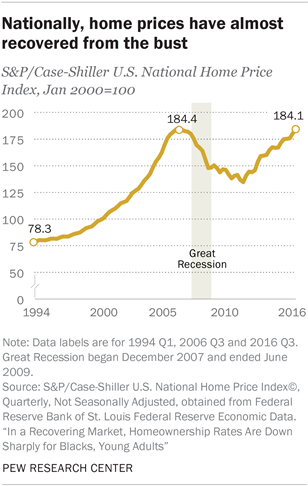
The Obama administration has a tendency to conflate the strong performance of Fed-induced “assets bubbles” with “strong economic growth.” Unfortunately, as is often the case these days, the “hard data” paints a slightly different picture than the “narrative” being pushed by Obama and his staff.
Per a new report from the Pew Research Center, and as our readers are undoubtedly aware, home prices have indeed recovered to pre-recession levels with a little help from Janet Yellen and crew.
That said, the Obama narrative breaks down from there as further research readily reveals that home prices have recovered despite a massive drop in overall homeownership rates.
Moreover, the folks that seem to have been hit the hardest are the ones that were the biggest supporters of Obama's “Hope & Change” agenda. Per the table below, homeownership rates among “Young Adults” and “Blacks” are down 18% and 16%, respectively, since the peak in 2004. And while that's definitely a big “Change,” its somewhat lacking on the “Hope.”

But if “mainstreet” Americans didn't drive Obama's housing recovery then who did? Perhaps the following Bloomberg headline can help answer that question:
Yes, the benefits of Obama's “housing recovery” accrued to none other than his “archenemy,” Wall Street, which poured $100's of millions into single-family houses on a weekly basis and $10's of billions over the past couple of years.
Adding insult to injury, this massive pace of investment has re-inflated the housing price bubble, making it, once again, nearly impossible for “Young Adults” and “Blacks” to afford homes. And, unlike in 2007 when subprime lending basically erased the need for down payments, homebuyers today are forced to “have some skin in the game” before banks will blindly give them $100,000's of dollars.
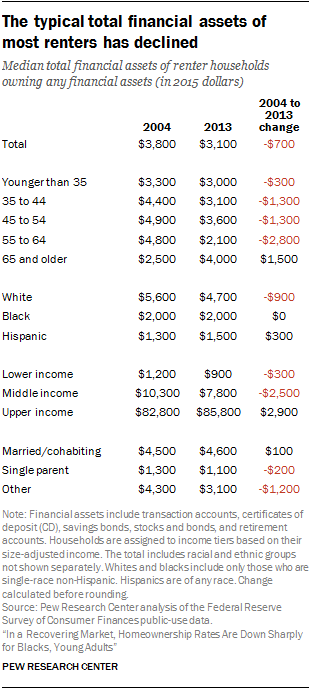
But, with the average American having about $3,000 in “financial assets,” we're not sure that's feasible.
But, as we always say, who needs facts when narratives are so much more fun.

Source: Obama "Housing Recovery" Crushes "Blacks, Young Adults" As Homeownership Rates Crash
A CNN analysis of federal financial disclosure documents details how Donald Trump’s campaign paid money to businesses related to him for services. …read more
Source: Trump paid millions to his businesses during race
By Tyler Durden

The Russians knew!!…
In a wonderfully ironic and perfectly consipiratorial result, Statista’s Dyfed Loesche notes that, it turns out that the Russian were best at predicting who would win the U.S. presidential elections. According to research by Ipsos, only two other countries, or rather a majority of respective citizens, were giving Trump the thumps-up before the race for the White House had started. The rest of the world was convinced that Hillary Clinton would win.
The Mexicans were most convinced that Clinton would make it – understandably so. (Sometimes it’s hard to distinguish wishful thinking from sober realism.) Strange though, that the British who had witnessed the Brexit vote in June didn’t have a stronger foreboding that you indeed should never say never. The respondents were questioned in the month leading up to the presidential election on November 8, 2016.
You will find more statistics at Statista
See – this proves Putin did it… and he told all the Russian people too!!!
Source: What Did The Russian People Know About The US Election Result?
Welcome to Esh Carmel Blog.