Colbert’s White House Correspondents legacy

Stephen Colbert’s White House Correspondents legacy …read more
Source: Colbert’s White House Correspondents legacy


Stephen Colbert’s White House Correspondents legacy …read more
Source: Colbert’s White House Correspondents legacy
By Tyler Durden

Submitted by Lance Roberts via RealInvestmentAdvice.com,
Last week, I noted technical breakout of the market above the downtrend line from last May, such a move required an increase in exposure to equity risk. To wit:
“With the breakout of the market yesterday, and given that ‘short-term buy signals’ are in place I began adding exposure back into portfolios. This is probably the most difficult ‘buy’ I can ever remember making.”
I also stated that it was probably a trap and that I will be stopped out in fairly short order. But that is the risk of managing money.
Well, since then the markets have gone, as of this writing, roughly nowhere as the market traded between roughly 2075 and 2100 all week. However, the following chart is what has me worried.
The chart of the volatility index measures the “fear of a correction” that currently exists in the market. As a contrarian indicator, the “time to sell” is when there is relatively little “fear” in the market. As the yellow highlighted bars suggest, that time is likely now.
Is the recent turn higher in the VIX signaling a market correction as it has done in the past? Possibly. If so, the question will be the depth of that correction. Will it be a mild pullback as saw in early 2015, or a more major decline as seen in August of last year? My bet is that it will likely be the latter given the weakening fundamental backdrop.
However, given the ongoing Central Bank interventions, verbal easing by the Federal Reserve and an excessiveness of “bullish hope,” there is still no telling what the markets will do next. This is why in this upcoming weekend’s newsletter (subscribe for free e-delivery) I will be discussing the possibility of “shorting against the box.”
Keith Fitz-Gerald once wisely stated:
“Always sit in an exit row.”
This weekend’s reading is focused primarily on the events from last week – The Fed and the markets. I suspect things are about to get much more interesting.

Dunkin’ Donuts plans to expand on-the-go ordering that allows customers to skip waiting in line for their coffee or food. …read more
Source: Dunkin’ is making it easier to get your donut fix
The Dow is down 300 points over the past two days, leaving the index on track for its worst week since early February. Blame fumbled earnings reports from the likes of Apple and Google as well as concerns about the Bank of Japan.
…read more
Source: Stocks suffer worst week since Feb. freakout
By Tyler Durden

Is Everyone Wrong On The “Causation” Of The Commodity Bubble? While it appeared 'retail' was responsible for the panic-buying chaotic volume surge in Chinese commodities, Axiom Capital Management's Gordon L Johnson points out that in fact… China Bank Special Interest Vehicles' “Bold” Commodity Speculation Is The Real Budding Black Swan
WMP Speculation Likely Cause for the ’16 Commodity Rally, Not Retail Investors (“Cab-Drivers”).
In ‘09 when deposit growth in China’s then ~$11tn banking system started to crash, China’s banks, in an attempt to avoid becoming illiquid while also maintaining their mandate to lend just 75% of deposits to maintain “healthy” bal. sheets, began issuing Wealth-Management-Products (“WMPs”) at an unprecedented clip. Without going into the nuances, WMPs are unregulated, off-bal. sheet (“OBS”), high-interest bearing savings-plans/money-mrkt-funds, which are comprised of banks’ riskiest loans (thus, their ability to offer rates above traditional bank savings accounts); they are also not required to reserve bank capital to cover potential defaults – these products often involve high-risk debts held by Chinese companies in industries beset by overcapacity.
WMPs are offered to investors via bank-controlled OBS Special Interest Vehicles (“SIVs”), which are capitalized with the proceeds from the WMP deposits from retail investors. The SIV then levers up (i.e., borrows) 5:1, or in some cases 10:1, via short-term/overnight paper (to keep the borrowing costs low [or the interest on the leverage would “kill” the SIV’s returns]) – CDO-like leverage on top of leverage – to generate the needed 5%-15% returns promised to retail investors.
Initially, the desired 5%-15% s-term WMP returns were met by the underlying high-risk loans, but then the loans went bad; then, they were targeted at real-estate, & shortly thereafter China’s real-estate mrkt crashed; subsequently, they targeted China’s stock mrkt, via margin lending, but when margin volumes collapsed 64% 6/15-3/16, this ave. to generate “quick returns” dried up.
Now, highly-levered WMPs are targeting the commodity-futures mrkts.
The proof? Well, while Shanghai rebar futures contracts avg.’d $180mn/day in Jan. ’16, this amount surged to $51.4bn/day in Apr. ’16 (a 285x increase) – yes, you heard that right. In fact iron-ore, coking-coal, & polypropolyene futures avg. daily trading values Apr. vs. Jan. ’16 are up 114x, 1,056x, & 150x.
Given the sheer scale (tens of trillions RMB), we blv this is all bank risk (not retail/cabbie-risk).
Crash Imminent? Given this is being funded by over-levered OBS entities of banks, the scale is enormous vs. both China’s economy & banks’ capital, & subsidization is mainly in the overnight mrkt – meaning one day we could wake up & it could all be “over” (via a rumor gov’t regulation is changing, a default, or interest rate vol.) – we blv a ’15-like Chinese mrkt crash in global commodities is nearing/inevitable.
Source: "A 2015-like Market Crash In Chinese Commodities Is Inevitable"
By Tyler Durden

After its earlier pump and rapid dump, WTI crude is unable to bounce for now despite the biggest rig count decline in 6 weeks. The oil rig count declined by 11 to 332 – the lowest since October 2009 – tracking lagged crude prices. If the co-dependence continues we would expect to see rig counts begin to rise (or stop declining) very soon. Total US rig count dropped to 420 – a new all-time record low.
Will we see rig counts stabilize here – tracking the legged price of crude?

Source: Crude Unable To Bounce Despite Biggest Rig Count Decline In 6 Weeks
By Tyler Durden

The initial refugee welcome in Germany is rapidly turning to rejection as the nation plan to ban EU migrants from most unemployment benefits for five years after arrival as a senior German politician has called for an “Islam law” that would limit the influence of foreign imams and prohibit the foreign financing of mosques in Germany.
As The FT reports, Germany is planning to ban EU migrants from most unemployment benefits for five years after their arrival in dramatic response to rightwing populist assaults on chancellor Angela Merkel’s liberal immigration policies.
The proposals, which are far tougher than had been expected even a few months ago, highlight the government’s concern over growing public anxiety about immigration and the related advance of the Alternative for Germany party, the most popular rightwing grouping since the second world war.
“I full and clearly support freedom of movement [of workers in the EU],” said labour minister Andrea Nahles, detailing the plans. “But freedom of access to social welfare is something else.”
It is a sign of how much the AfD is shaking German politics that the proposals come from Ms Nahles, a leftwing social democrat. The SPD is suffering even more than Ms Merkel’s CDU/CSU bloc in the face of the AfD’s advance. Opinion polls show it around 20 per cent, an all-time low.
The German debate on curbing EU migrants’ benefits echoes the intense arguments in the UK, as it prepares for its EU membership vote in June. Ms Merkel has previously promised to work with prime minister David Cameron in cutting welfare abuse.
And as if that was not 'welcoming' and 'integrative' enought, The Gatestone Institute's Soeren Kern reports a senior German politician has called for an “Islam law” that would limit the influence of foreign imams and prohibit the foreign financing of mosques in Germany.
“All imams need to be trained in Germany and share our core values. … It cannot be that we are importing different, partly extreme values ??from other countries. German must be the language of the mosques. Enlightened Europe must cultivate its own Islam.” – Andreas Scheuer, the General Secretary of the Christian Social Union party (CSU).
The Turkish government has sent 970 clerics — most of whom do not speak German — to lead 900 mosques in Germany that are controlled by a branch of the Turkish government's Directorate for Religious Affairs. Turkish clerics in Germany are effectively Turkish civil servants who do the bidding of the Turkish government.
Erdogan has repeatedly warned Turkish immigrants not to assimilate into German society. During a trip to Berlin in November 2011, Erdogan declared: “Assimilation is a violation of human rights.”
The proposal — modelled on the Islam Law promulgated in Austria in February 2015 — is aimed at staving off extremism and promoting Muslim integration by developing a moderate “European Islam.”
The move comes amid revelations that the Turkish government is paying the salaries of nearly 1,000 conservative imams in Germany who are leading mosques across the country. In addition, …read more
Source: Germany Moves To Ban Refugees From Welfare; Politician Calls For "Islam Law" To Limit Influence

Martin Sorrell, the long time CEO of advertising company WPP, made $102 million in 2015. …read more
Source: Is this CEO worth 1,444 times what he pays his workers?
By Tyler Durden

Despite surging stock prices in April, UMich’s final Consumer Sentiment print slipped to 89.0 (from 89.7 prelim and 91.0 previous) notably below expectations and the lowest since September 2015. Under the covers though, it was “hope” that really plunged, as Consumer expectations dropped to 77.0 – the lowest since September 2014. However, worst of all for The Fed is that medium-term inflation expectations tumbled back to 2.5% record lows.
Hope is plunging…
As inflation expectations tumbled back to record lows…

Source: Consumer "Hope" Slumps As Inflation Expectations Hit Record Lows
By Tyler Durden
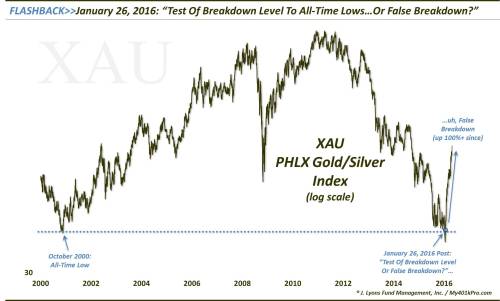
A key index of gold stocks is hitting its first level of major potential resistance since its false breakdown to all-time lows in January.
Flashback to January 26 of this year. The PHLX Gold/Silver Index, or XAU – the longest running index of gold stocks – was recovering from its breakdown earlier in the month to all-time lows. That day, the XAU was testing the breakdown level around $43. Our Chart Of The Day and accompanying post linked above queried “Will this test of the breakdown level lead to a false breakdown, or the start of a new leg down?” Well, 3 months and over 100% later, that answer couldn’t be more clear.
The question now is “How far will the post-false breakdown rally go?” Fast forward to today and, in our view, the rally in the XAU is hitting its biggest challenge yet in terms of potential resistance on it chart. Consider the levels of consequence near the $86 level as laid out on the chart below:
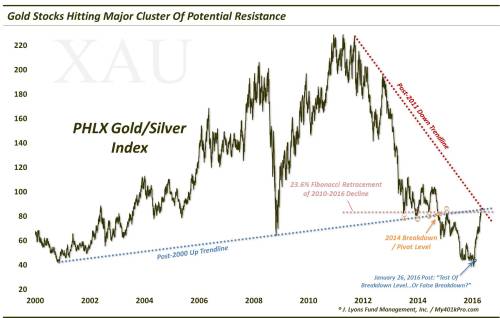
The XAU traded above this resistance today, reaching nearly $88 before closing at $86.90. Is that enough to signal a breakout of this resistance? Not in our view. It will take a much more decisive move above $86 to convince us that it has overcome the resistance. This is due in part to the variability of these lines of resistance, considering their long-term nature, especially the post-2000 Up trendline.
Furthermore, it would be much healthier and constructive to see the XAU consolidate near these levels a bit longer to “digest” the 100%+ gain of the past 3 months. By running straight through these levels after almost no pause (~6 days) when it is so extended, the XAU runs the risk of exhaustion and a failed breakout. That action could lead to a more prolonged and damaging pullback than if it simply consolidated for a bit longer before breaking out.
Regardless of how things transpire, in our view, above roughly $86 in the XAU appears to be bullish, opening up potential upside to above $110 as the next level of resistance. Below $86 and the index could struggle. Again, this wouldn’t necessarily be a terrible thing if the XAU consolidated its recent gains before launching the next leg higher. Roughly the $70 level may be the best level of support below should the XAU pause here.
The last time we mentioned that gold stocks may be at an important juncture, they went on to rally over 100%. While this juncture may not be as critical, it could be the biggest test yet in the impressive gold stock rally.
* * *
More from Dana …read more
Source: Rally In Gold Stocks Reaches First Big Challenge
Welcome to Esh Carmel Blog.


