Colbert, Fallon & Meyers prep for Trump’s inauguration

Stephen Colbert brought back his old “Colbert Report” persona to say goodbye to President Obama. …read more
Source: Colbert, Fallon & Meyers prep for Trump’s inauguration


Stephen Colbert brought back his old “Colbert Report” persona to say goodbye to President Obama. …read more
Source: Colbert, Fallon & Meyers prep for Trump’s inauguration
By The_Real_Fly
At the end of the Bush administration, I hated the republicans. George was such a fucking idiot, alongside the tea party retards. I viewed Obama as a welcomed respite. In hindsight, I probably voted for Obama to prove that I wasn’t some sort of redneck racist.
The Obama administration was very good for stocks — maybe the best ever. But at what cost?
The national debt has doubled, borrowing more than $9 trillion since 2008 and the Fed’s balance sheet has gone from $700 billion to $4.5 trillion. This whole economy is a fucking illusion, a sham. Try to unwind those positions and start paying down that debt and you’ll see the true nature of the economy and the markets.
Obama did nothing, other than kick the can down the road — passing on a nuclear time bomb for future generations. By that fact alone, I consider Obama a grandiose failure, of the community organizing varietal. I’m not even going to get into the wars and his social policies — which has laid waste to the social fabric of America.
So what stocks did the best over the past 8 years, an era defined by crony capitalism, massive advances in technology, and social networks?
BAD NEWS FOR TRADERFAGS. Most of the big winners were held captive by FRED ‘Fucking’ WILSON and his crony capitalist VC pigs. Those greedy fuckers presided over monumental gains in social networks. Here are a few.
Facebook: $4b valuation in 2008 to $363b today.
Twitter: $1.5m valuation in 2008 to $12.3b today.
Yelp: $200m valution in 2008 to $3.2b today.
Snapchat: $485k in 2012 to $25b today.
Airbnb: $20k valuation in 2009 to $30b today.
Uber: $200k valuation in 2009 to $70b today.
That’s where the real money was made. Let’s see what scraps were left over for us — the little rich people.
$TREE +5,130%
$NFLX +4,415%
$JAZZ +4,400%
$DPZ +3,517%
$MKTX +3,300%
$PCLN +3,100%
$ULTA +3,000%
$INCY +2,800%
$MGPI +2,800%
$PPC +2,200%
$PRSC +1,700% (literally a welfare play)
And here were the losers.
$BBRY -85%
$APOL -85%
$SPWR -79%
$SHLD -77%
$FSLR -76%
$RIG -75%
$AVP -73%
$FRO -73%
$CYH -66%
$JCP -66%
$CHK -65%
$BBG -64%
Notice any trends? Which will be the biggest winners and trends under Trump?
I saw a world in need of automation, superfluous comforts indicative of a nation with plenty of excess. It was an era of wanton hedonism for the elite, and a grueling struggle for everyone else. One cannot discuss Obama without thinking about healthcare — his cornerstone issue during his time in office. It failed and now we have to deal with the ramifications.
Content originally generated at iBankCoin.com
Source: Here Were the Biggest Winners and Losers During Obama’s Reign of Terror
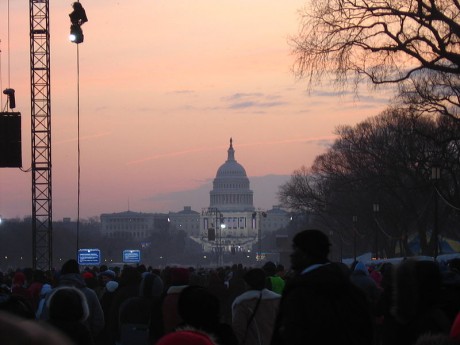
Over the past couple of months, the radical left has been endlessly hyping the protests against Donald Trump on January 20th and January 21st. We have been told that half the population absolutely hates Donald Trump and that Washington D.C. will be filled with angry protesters that are ready to take their country back. So where are they? The radical left tends to talk a good game, but when it comes time for action they often come up way short. At this point, it appears that the much-hyped “war in the streets” that they were promising is going to be a giant dud.
Reports from those on the scene in D.C. indicate that there are very few protesters running around. Yes, a few hundred LGBT activists danced in front of Mike Pence’s home on Wednesday night. And yes, police fired pepper spray at protesters at one point on Thursday night…
Police and anti-Donald Trump protesters are clashing in a rally that began outside the Trump International Hotel in Washington D.C.
The protest started at the hotel, and then marched through D.C. to the National Press Club several blocks away. Once there … pepper spray was fired into the crowd, and protesters started trying to break through police lines.
One protester got a little bloody during the pepper spray incident, but so far that has been it.
So where are the “Ferguson-style protests” that we were promised?
Of course the truth is that these radical leftists never stood much of a chance in the first place. Law enforcement authorities have been watching them like a hawk, and the heart of Washington D.C. has been turned into a “fortress” for the inaugural festivities.
According to Reuters, permits have been granted for at least 30 anti-Trump rallies in D.C., but so far it appears that the “army of protesters” that many were dreaming of has failed to materialize.
And the authorities in D.C. appear quite ready to handle whatever is thrown their way. Numerous media reports today used the term “fortress” to describe the level of security immediately surrounding the U.S. Capitol…
About 28,000 security personnel, miles of fencing, roadblocks, street barricades and dump trucks laden with sand are part of the security cordon around 3 square miles (almost 8 square km) of central Washington.
But even at this late hour, the mainstream media continues to hype the possibility of chaos and violence. For example, the National Press Photographers Association is warning of Ferguson-style rioting on Friday…
The National Press Photographers Association has issued guidelines to journalists that virtually mirror those sent out during the Ferguson riots in 2014.
Reporters are advised to “maintain situational awareness” and have “an exit plan in case the situation becomes hostile”.
The group also emphasizes that journalists should “move toward the nearest police officer under the assumption that they could protect you from hostile or violent protesters.”
Other mainstream media outlets have been openly discussing the possibility of some sort of catastrophic terror attack during the Inauguration. If you can …read more
By Tyler Durden

Submitted by Mike Krieger via Liberty Blitzkrieg blog,
At this point, I’ve seen enough. It’s becoming quite clear that Facebook’s Mark Zuckerberg wants to be President of these United States.
The topic first piqued my interest about a week ago when I read an article published at Vanity Fair titled, Will Mark Zuckerberg be Our Next President?
Increasingly, a number of influential people in Silicon Valley seem to think that Mark Zuckerberg will likely run for president of the United States one day. And some people, including myself, believe that he could indeed win. “He wants to be emperor” is a phrase that has become common among people who have known him over the years.
We’ll get to my theory on what that means a little later. First, let’s zip through the myriad indications that he might choose to throw his hoodie into the ring. Last year’s Facebook proxy statement articulated that Zuckerberg can run for office and still maintain control of his company. (To this end, Trump’s controversial precedent may facilitate any thorny political complications regarding the matter.) Then, over the holidays, Zuckerberg responded to a question about being an atheist, a belief he once professed, with a decidedly more politically circumspect answer: “I was raised Jewish and then I went through a period where I questioned things, but now I believe religion is very important.” (No one likes a president who doesn’t believe in some sort of God.) More recently, President Obama’s former campaign manager, David Plouffe, joined the philanthropic Chan Zuckerberg Initiative, to lead policy and advocacy. Other politicians from both parties have also joined the organization. And then there was the most obvious intimation: earlier this year, Zuckerberg, who has a habit of posting his annual New Year’s resolution on his Facebook page, declared that after conquering the previous challenges of learning Mandarin, and building an artificial-intelligence butler for his home, this year he was going to meet “people in every state in the US.” He noted that he’s “spent significant time in many states already, so I’ll need to travel to about 30 states this year to complete this challenge.” I wonder how many of those states are swing states?
If he does want the job, Zuckerberg definitely has the personality for it. When Facebook went public in 2012, I co-authored a profile of the young C.E.O. During the reporting, I heard from several friends about his penchant for playing world-conquering board and video games. Early childhood pals told me that one of Zuckerberg’s favorite video games as a boy was Civilization, the game in which you have to “build an empire to stand the test of time.” Others have told me that, to this day, Zuckerberg loves to play Risk, a strategy board game where you have to essentially take over the world. Believe it or not, he ended up applying some of these theories while forging and managing the extraordinary growth …read more
Source: "He Wants To Be Emperor" – How Mark Zuckerberg Is Scheming To Become President

100% Pure Garcinia Cambogia Extract – Appetite Suppressant – Carb Blocker Capsules – 2100 MG – 90 Caps
Looking for something special ? Find The Lowest Price HERE

Economists expect official figures to show that China’s economy maintained its “uncanny stability” by growing at 6.7% for a fourth consecutive quarter. …read more
Source: China sees weakest annual economic growth in 26 years
By Tyler Durden

Following her Trump-weaker-dollar-destroying performance yesterday, Fed chair Janet Yellen reprises her role as Mnuchin-slayer tonight with an appearance at Stanford's Institute for Economic Policy Research. In a speech entitlted “The Economic Outlook and Conduct of Monetary Policy” she is expected to deliver a similarly hawkish tone confirming multiple rate hikes (though no rush) and potentially erasing the dollar weakness from today…
Janet Yellen Live Feed (due to begin at 2000ET)…
As a reminder, here is her speech from yesterday:
Good afternoon. It is a pleasure to join all of you at the Commonwealth Club for lunch today, not the least because the club and the Federal Reserve have a few things in common. Both organizations, as it happens, have a board of governors and a chair. And both the club's and the Fed's histories extend back more than a century. The club, as many here know, was founded in 1903, and the Federal Reserve a decade later. Perhaps because of our shared origins in the Progressive Era, a period of reform in American life, we hold certain values in common. According to your website, the club is nonpartisan and dedicated to the impartial discussion of issues important to your community and the nation. At the Fed, we too are nonpartisan and focused squarely on the public interest. We strive to conduct our deliberations impartially and base our decisions on factual evidence and objective analysis. This afternoon I will discuss some challenges we've faced in our recent deliberations and may face in the next few years.
Perhaps, though, it is best to start by stepping back and asking, what is–and, importantly, what isn't–our job as the nation's central bank? And how do we go about trying to accomplish it? The Federal Reserve has an array of responsibilities. I'll mention our principal duties and then focus on one–monetary policy, the responsibility that gets the most public attention.
In addition to monetary policy, we–in collaboration with other regulatory agencies at both the federal and state levels–oversee banks and some other financial institutions to ensure they operate safely and soundly and treat their customers fairly. We monitor the financial system as a whole and promote its stability to help avoid financial crises that could choke off credit to consumers and businesses. We also reliably and safely process trillions of dollars of payments for the nation's banks and the federal government and ensure that banks have an ample supply of currency and coin to meet the demands of their depositors. And we work with communities, nonprofit organizations, lenders, educators, and others to encourage financial and economic literacy, promote equal access to credit, and advance economic and community development.
But, as I noted, monetary policy draws the most headlines. What is monetary policy, exactly? Simply put, it consists of central bank actions aimed at influencing interest rates and financial conditions more generally. Its purpose is to help foster a healthy economy. But monetary policy cannot, by itself, create a healthy economy. It cannot, for instance, educate young people, generate …read more
Source: Janet Yellen Speaks Again – Live Feed
By Tyler Durden

In 2012, Jon Wheatley bought a $40,000 apartment in Las Vegas so that he could rent it out on Airbnb .
“I was surprised by just how cheap real estate was in Las Vegas,” says the British-born Wheatley. “I didn’t want to live in Vegas, and I wasn’t planning on being there very much. So when I looked at Airbnb, it looked almost too good to be true.”
Wheatley looked at the rates of similar apartments on Airbnb, and he decided that the apartment could pay for itself. He bought the flat and spent 3 weeks and $10,000 on furniture and renovations. After a year of remotely renting out the apartment, he says , he’d made $13,000 in profit.
When we ask if he recommends doing this, he replies, “One hundred percent. The model definitely works.”
In only 8 years, Airbnb’s premise—to allow someone to host a business traveler in a spare bedroom, or a family to rent their apartment to tourists while they’re out of town—has made it a $25 billion company . Co-founder Brian Chesky often talks about how anyone can turn extra space in their home into an asset that helps them pay their rent.
But the economics of short term rental sites Airbnb and VRBO also appeal to people who do not live in the house or apartment they rent out. This includes go-getters like Wheatley, as well as professional real estate investors.
Outside the real estate scene, however, this development has not been met with a positive reaction. In cities like San Francisco and New York, where housing is a scarce, politicized resource, the prevalence of property owners renting out multiple apartments has inspired protests, critical press, and the attention of regulators and lawmakers.
Photo via Airbnb
What’s missing from the already fractious debate over Airbnb, however, is the fact that the big players in the real estate market aren’t involved. At least, they aren’t involved yet .
Companies like AvalonBay and Camden Property Trust own tens or hundreds of thousands of units, and they spend hundreds of millions of dollars buying and constructing residential buildings. These companies normally rent out apartments to people who sign year-long leases. But they could instead rent them out on sites like Airbnb. We partnered with Priceonomics to investigate whether this real estate investing trend could spread to these big players.
At this point, we’re seeing that the uncertainty created by municipal debates over how to regulate Airbnb is keeping major investors out of the short-term rental game. For individual investors, however, the door is more or less wide open.
The Rise of the Professional Airbnb Investor
The financial benefit of an Airbnb property is clear to investors. They can make more money from short term rentals for the same reason you typically spend more on …read more
Source: Will Real Estate Investors Take Over Airbnb?
By Tyler Durden

Submitted by Peter Schiff via Euro Pacific Capital,
There is much we don’t know about how the Trump presidency will play out. Will the Wall get built? Who will pay for it? Will it have at least some fencing? Will repeal and replace happen at exactly the same time? Will Trump throw a ceremonial switch? Will there be a Trump National Golf Course in Sochi? It’s anyone’s guess. But of one thing we can be fairly certain. President Trump is very likely to preside over the largest expansion of Federal budget deficits in our history. Trump has built his companies with debt and I’m sure he thinks he can do the same with the country. His annual budget deficits are likely going to be huge. This development will make a greater impact on the investment landscape than most on Wall Street can imagine.
In the past half-century, Republican presidents have been the going away winners at the deficit derby, a fact that should make any true conservative blush. The sad truth is that annual deficits exploded under Ronald Reagan and George W. Bush, and generally contracted under Bill Clinton and Barack Obama (despite the latter's distinction of having added more total debt than all previous presidents combined.) Some of the explanation is just luck of the draw, some walked into office in the midst of recessions they didn’t create. But the better part of the explanation is baked into the political dynamics.
Democrats want to raise spending and taxes. Republicans want to cut spending and taxes. But whereas Democrats have generally succeeded on both of their missions, Republicans have just succeeded in one. (Actual spending cuts require politically difficult choices that are much harder to vote for than perennially popular tax cuts). This puts a giant thumb on the Republicans’ budgetary scale.
Like prior Republicans, Trump has promised to cut taxes, on both corporations and individual taxpayers…even the wealthy. But unlike prior Republicans, he has not paid a word of lip service to spending cuts. He has promised to spend now, and spend big. Trump just doesn’t do the austerity thing. It’s for losers.
In addition to fronting the cost of building the 2,000 mile Wall (accounts receivable has a reliable address in Mexico), Trump plans big increases in military spending, both on active military and on our veterans. His reboot of Obamacare has yet to be presented, but as he has promised that no one will lose coverage, not even those with pre-existing conditions, we can be sure that Trumpcare won’t be cheap. But his big project will likely be his promised $1 trillion plus infrastructure spending plan. Most importantly, he diverges from most Republicans by promising no structural changes in Social Security and Medicare, the entitlement leviathans that are the sources of the vast majority of Federal red ink.
To aid him in these budget-busting efforts, Trump will have the benefit of a compliant Congress in which his own party controls both Houses. Most Republican senators and representatives now seem eager to …read more
Source: Peter Schiff Warns "Trump Deficits Will Be Yuuge": What That Means For Gold & The Dollar

Paul McCartney filed a lawsuit against Sony/ATV in an attempt to regain the copyrights to a long list of Beatles hits that he either wrote or co-wrote. …read more
Source: Paul McCartney sues to get songs back from Sony
Welcome to Esh Carmel Blog.



