
U.N. Official ‘Accidentally’ Crushes Own Throat Right Before Testifying Against Hillary Clinton
By Tyler Durden

Submitted by Mac Slavo via SHTFPlan.com,
Call it conspiracy theory, coincidence or just bad luck, but any time someone is in a position to bring down Hillary Clinton by testifying they wind up dead. In fact, there’s a long history of Clinton-related body counts, with scores of people dying under mysterious circumstances.
Perhaps the most notable is Vince Foster. Foster was a partner at Clinton’s law firm and knew the inner workings of the Clinton Machine. Police ruled that death a suicide, though it is often noted that Foster may have been suicided.
Now, another official has found himself on the wrong end of the Clintons. That John Ashe was a former President of the United Nations General Assembly highlights the fact that no one is safe once in their sights.
And as you might have guessed, there are major inconsistencies with Ashe’s death. It was not only conveniently timed because Ashe died just a few days before being set to testify against Clinton in a corruption case, but official reports indicated he died of a heart attack.
The problem, however, is that police on the scene reported Ashe died when his throat was crushed during a work-out accident.
The New York Post’s Page Six reported that after Ashe was found dead Wednesday, the U.N. claimed that he had died from a heart attack. Local police officers in Dobbs Ferry, New York, later disputed that claim, saying instead that he died from a workout accident that crushed his throat.
Adding to the mysterious nature of Ashe’s death was the fact that he had been slated to be in court Monday with his Chinese businessman co-defendant Ng Lap Seng, from whom he reportedly received over $1 billion in donations during his term as president of the U.N. General Assembly.
And then there was this: During the presidency of Bill Clinton, Seng illegally funneled several hundred thousand dollars to the Democrat National Committee.
Source: The Conservative Tribune via The Daily Sheeple
It must be coincidence, right?
If former Secret Service agent Gary Byrne is to be believed, this is business as usual for the Clintons. Excerpt via Zero Hedge:
BYRNE: I feel so strongly that people need to know the real Hillary Clinton and how dangerous she is in her behavior. She is not a leader. She is not a leader.
SEAN: She does not have the temperament?
BYRNE: She doesn’t have the temperament. She didn’t have the temperament to handle the social office when she was First Lady, she does not have the temperament.
SEAN: She’s dishonest.
BYRNE: She’s dishonest, she habitually lies, anybody that can separate themselves from their politics and review her behavior over the past 15 years…
Byrne is the author of the newly published book Crisis Of Character – a first-hand Clinton exposé.
Price To Sales Ratio – Another Nail In The Market’s Coffin?
By Tyler Durden
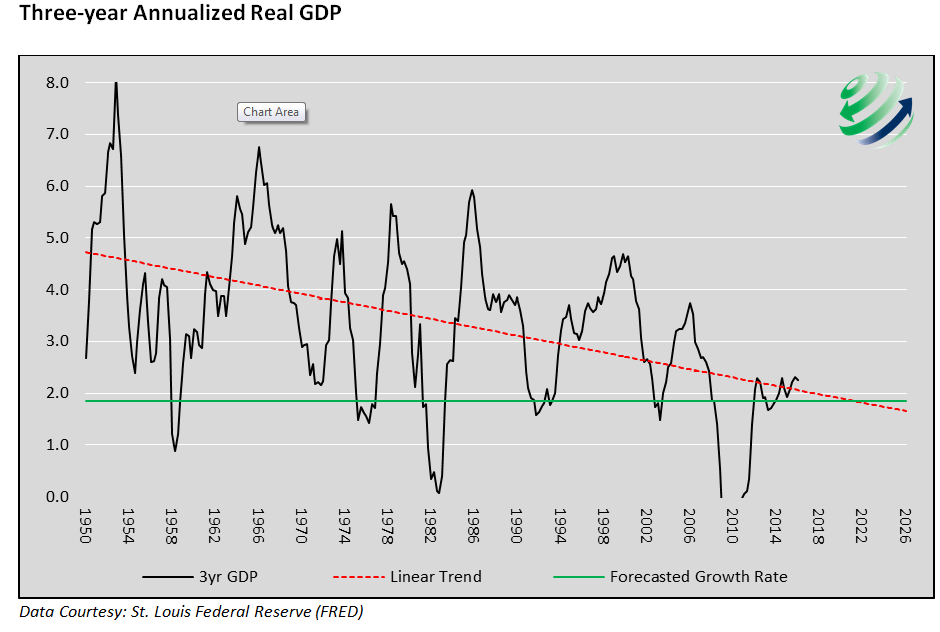
Authored by Michael Lebowitz of 720Global.com (via RealInvestmentAdvice.com),
720 Global has repeatedly warned that U.S. equity valuations are historically high and, of equal concern, not properly reflective of the nation’s weak economic growth potential. In this article we provide further support for that opinion by examining the ratio of equity prices to corporate revenue also known as the price to sales ratio (P/S). At its current record level, the P/S ratio leads us to one of two conclusions: 1) Investors are extremely optimistic about future economic and earnings growth or 2) Investors are once again caught up in the frenzy of an equity bubble and willing to invest at valuations well above the norm.
Either way, the sustainability or extension of the current P/S ratio to even higher levels would be remarkable. What follows here is an exercise in logic aimed at providing clarity on the topic.
Before showing you the current P/S ratio in relation to prior market environments, it is important to first consider two related concepts that frame the message the market is sending us.
Concept #1 – Investors should accept higher than normal valuation premiums when potential revenue growth is higher than normal and require lower than average premiums when potential revenue growth is lower than normal.
Consider someone who is evaluating the purchase of one of two dry cleaning stores (A and B). The two businesses are alike with similar sales, pricing, and locations. However, based on the buyers’ analysis, store A’s future revenue is limited to its historical 2% growth rate. Conversely, the potential buyer believes that store B, despite 2% growth in the past, has a few advantages that are underutilized which the buyer believes can potentially produce a revenue growth rate of 10%. If stores A and B are offered at the same price the buyer would most likely opt to purchase store B. It is also probable the buyer would be willing to pay a higher price for store B versus store A. Therefore highlighting that revenue growth potential is a key factor when deciding how much to pay for a business.
Purchasing a mutual fund, ETF or an equity security is essentially buying a claim on a potential future stream of earnings cash flows, just like the dry cleaning business from the prior example. The odds, therefore, of a rewarding investment are substantially increased when a company, or index for that matter, offering substantial market growth potential is purchased at a lower than average P/S ratio. Value investors actively seek such situations.
Logically one would correctly deduce that P/S ratios should tend to follow a similar directional path as expected revenues.
Concept #2 – Corporate earnings growth = economic growth
Corporate earnings growth rates and economic growth rates are nearly identical over long periods. While many investors may argue that corporate earnings growth varies from the level of domestic economic activity due to the globalization of the economy, productivity enhancements that lower expenses for corporations, interest rates and a host of other factors, history proves otherwise.
Since …read more
Source: Price To Sales Ratio – Another Nail In The Market’s Coffin?


Hedge Funds No Longer Have Any Idea How To Trade This Market
By Tyler Durden

Several days ago we posted an update to our favorite trading strategy since 2013: namely betting on the stupidity of the “smart money” and going long the most underowned and hated names, while shorting the most owned ones (recall from September 2013: “”Presenting The Best Trading Strategy Over The Past Year: Why Buying The Most Hated Names Continues To Generate “Alpha“”). As Bank of America confirmed three years later this past Wednesday, this indeed remains the best alpha-generating strategy. Here is what BofA’s Savita Subramanian said:
As flows from active to passive funds have accelerated, one strategy that has worked unusually well for the last several years is a simple positioning trade of selling the 10 most overweight stocks and buying the 10 most underweight stocks by active managers. This single trade has yielded over 16ppt of alpha year-to-date. And implied derisking/ outflows on Brexit alone have been fierce, with the same strategy generating 5.2ppt of alpha just since last Thursday’s close. Even if Brexit’s impact on funds is limited from here, we believe that crowded stocks will likely continue to underperform neglected stocks: a whopping two-thirds of US large cap AUM still resides in active funds – there is likely a lot more to go in the rotation from active to passive.
Here is the proof: “the Top 10 most overbought stocks have trailed the S&P for each of the past three years, while the Top 10 “most neglected” stocks outperformed the S&P on average by 11.6%.”

However, while we would be delighted to take this latest opportunity to gloat, there is a more troubling undertone to this data. Indeed, while we sarcastically pointed out back in 2013 that with the Fed (and now every other central bank) as the market’s Chief Risk Officer, there is no longer a need for anyone to do fundamental analysis, this has not only come true but the outcome is now is far worse. Because it confirms what we have said all along: not only is there no market left aside from what Central Banks decide will happen to “risk assets” on any given day, but the smart money – both hedge and mutual funds – have now completely lost the plot.
For the evidence look no further than the charts below: the first two charts show the relative performance of Goldman’s Hedge Fund VIP basket, the same stocks that comprise the most popular holdings among US hedge funds. Incidentally, this is also the same holdings which back in February we reported that Goldman was trying to make into an ETF in an attempt to offload the most concentrated hedge fund holdings into muppet hands (it failed) and which we added 5 months ago that the “the guaranteed way to make money with this ETF would be to short it” We were right.
The second chart shows that, as we said in 2013, the best offsetting strategy remains to go long the most hated names. It has been pretty much …read more
Source: Hedge Funds No Longer Have Any Idea How To Trade This Market
Queen Urges "Keep Calm" As Scotland Seeks To Block Brexit
By Tyler Durden

“If there is a way to stay in the EU, I am determined to pursue it,” proclaimed Scottish First Minister Nicola Sturgeon in an interview with Greece's To Ethnos newspaper, noting that Scottish parliament is looking into legal grounds for a new referendum on secession from UK. This confirms JPMorgan's base case that Scotland will vote for independence and institute a new currency at that point. Shortly after Sturgeon's comments, The Queen made her first post-Brexit speech (ironically in Scottish parliament) urging Britons to “stay calm and focused,” pointedly noting “real leadership requires deeper and more dispassionate thinking in turbulent times.”
A nation divided…
Whih explains why Scotland is looking into legal grounds for holding new referendum on secession from UK, Scottish First Minister Nicola Sturgeon is cited as saying in interview with Greece’s To Ethnos newspaper. As Bloomberg reports,
Other means are being examined in order to block Brexit include debate and vote in Scottish parliament, which would create constitutional issue for UK.
“We are in uncharted waters,” Sturgeon says, adding that “all options are on the table”
“Scotland will continue to consider EU citizens welcome to reside and work in the country”
“If there is a way to stay in the EU, I am determined to pursue it,” first minister says, adding that she is very satisfied from her exchanges with EU officials in Brussels.
Main motive behind decision of many Scots to vote against independence was that staying part of the UK meant staying part of the EU; that motive doesn’t exist anymore, “thus creating new conditions”
* * *
Still, as we also cautioned previously, any veto or scuttling threat may be merely Scotland clutching at straws.
Scottish Secretary and Conservative MP David Mundell said: “We have to respect the result on Thursday, even if we don't like it – it was a UK wide vote – it was a vote by people across the UK.”
Asked about the possibility of Scotland stopping Brexit, he said: “What we need to see is the legal mechanism that we go through to get to a situation of the UK leaving” and then said clearly that “I personally don't believe the Scottish Parliament is in position to block Brexit, but I haven't seen the legal documentation that you refer to in your interview with Nicola [Sturgeon].”
It is unclear what the final legal determination will be on this subject, but if somehow Scotland does succeed in scuttling a historic referendum decision by the majority of the UK population, we urge Edinburgh to build a very big and vary tall wall on its southern border that Hadrian would be proud of (ideally without waiting for Mexico, or the UK, to pay for it).
Meanwhile, as all this takes place, the UK ruling class is in a state of crisis, with both PM Cameron and Chancellor Osborne having disappeared, while the opposition Labour party is undergoing a real time coup attempt, in which as we reported yesterday, party leader Jeremy Corbin has been firing random …read more
Source: Queen Urges "Keep Calm" As Scotland Seeks To Block Brexit
Hillary Cracks, Gives FBI A "Voluntary" Three Hour Interview Over Private Email Server
By Tyler Durden

Having previously said she would not be voluntarily subjugated to an interview by the FBI in the agency’s probe surrounding Hillary Clinton’s email server, moments ago NBC reported that the Democratic presidential candidate, seemingly shaken by last week’s events when a meeting between her husband and the US Attorney General Loretta Lynch has sparked a scandal suggesting there is backdoor collusion between the Clintons and the DOJ and that, as Judicial Watch put it, the “fix is in“, has given a “voluntary” three and a half hour interview to the FBI over the use of her private email server.
As NBC reports, “presumptive Democratic nominee Hillary Clinton was questioned by the FBI in a long-awaited interview Saturday over the use of her private email server, an aide said. The interview’s purpose was to delve into whether Clinton mishandled classified information submitted on her private email system while she served as secretary of state. Her top staffers have already given testimony.”
The interview happened at the FBI headquarters in Washington, D.C. It lasted approximately three and a half hours.
“Secretary Clinton gave a voluntary interview this morning about her email arrangements while she was Secretary. She is pleased to have had the opportunity to assist the Department of Justice in bringing this review to a conclusion. Out of respect for the investigative process, she will not comment further on her interview,” Nick Merrill, a Clinton spokesman, said in a statement.
As NBC adds, the fact that the interview was “voluntary”, means there was no subpoena. It is unclear if Hillary had been sworn in.
Use of word “voluntarily” in the context of @HillaryClinton FBI interview means there was no subpoena.
— Kelly O’Donnell (@KellyO) July 2, 2016
The interview also means that the investigation is coming to an end and that a charging decision will soon be made (or not).
Rumors that the FBI interview was to take place Saturday, first reported by The Daily Caller, emerged as the Clinton campaign was mired in controversy over a meeting between Attorney General Loretta Lynch and former President Bill Clinton. The two met on Lynch’s airplane on a tarmac in Phoenix on Monday. The attorney general insisted their talk was purely “social” and said they didn’t talk about the emails that the Justice Department are currently reviewing. But she expressed regret Friday for the meeting.
As some have suggested, the rapidly escalating scandal from the meeting between Lynch and Bill Clinton which even David Axelrod admitted was “bad optics”, may have pushed the DOJ to actually do its job, and to accelerate the FBI’s probe. As to whether Hillary will ever be indicted, we are not holding our breath.
Today’s cover: Lynch may be forced to charge Hillary after Bill’s shady powwow https://t.co/GKN6FsMzk1 pic.twitter.com/gn3rYqdxLc
— New York Post (@nypost) July 2, 2016
CLSA Reminds Everyone: The Economy Was Struggling Long Before Brexit
By Tyler Durden

As a result of Brexit, we pointed out that companies now will have a convenient scapegoat for any future earnings misses, or at the very least use Brexit as a reason to lower guidance for the remainder of the year without any pushback from analysts.
We also noted that with the referendum behind us, everyone would conveniently forget that earnings expectations had already been continuously revised down for quite some time now, long before Brexit.
But if you don't want to take our word for it, here is CLSA reminding everyone as well.
In a recent note, CLSA wrote that world trade growth had hit a new post-global financial crisis low long before Brexit ever came about.
From CLSA
World trade growth hits new low
The UK’s surprise Brexit vote has caused a spike in risk perceptions but even before the vote the global economy was struggling. With the March data world trade growth hit a new post-GFC low. Emerging Market demand has contracted on a YoY basis for six back-to-back months. And developed economy demand has weakened, from +3.7% YoY in the three months to November 2015 to 1.2% YoY in the three months to March
* * *
Of course this won't stop companies from using Brexit as a hall pass in order to explain away any and all misses and forward guidance revisions, and it also won't stop analysts from using the infamous “one-time adjustment” line in order to paper over the weaker earnings, but it is good to keep this in mind that the new narrative isn't the whole truth.

Source: CLSA Reminds Everyone: The Economy Was Struggling Long Before Brexit
All Eyes Now Turn To FBI Director Jim Comey In Clinton Investigation
By Tyler Durden

News about any FBI activity as it relates to the investigation into Hillary Clinton has been sparse lately, and as we noted earlier, the fact that it has been relatively quiet may be a growing concern inside the Clinton camp. However, due to the fallout from the recent private meeting between Attorney General Loretta Lynch and Bill Clinton, the spotlight is now squarely shining on the FBI, and director Jim Comey in particular.
Recall that immediately after the public learned of the purely coincidental meeting, Lynch went into pure damage control mode. After simply telling reporters that all the two discussed was Bill’s golf game and his grandchildren wasn’t enough to quiet the questions surrounding the true intent of the meeting, Lynch decided to have a televised interview in order to clarify everything. During the interview, Lynch said that while she wasn’t formally recusing herself from the decision whether or not to bring charges against Hillary, Lynch said that whatever recommendations were given from the department’s career prosecutors and investigators, as well as the FBI director, would be accepted. Ironically, Lynch said that the decision to accept those recommendations was made long before the meeting with Clinton.
“While I don’t have a role in those findings and coming up with those findings or making those recommendations as to how to go forward, I’ll be briefed on it and I will be accepting their recommendations,” Lynch said during the interview.
With that said, as The Hill points out, the attention has now shifted to FBI Director Jim Comey and whether or not the FBI will recommend that the DOJ bring charges against Clinton.
“Comey is the center of gravity on this thing. There is a growing expectation that we the public need to hear the FBI, Jim Comey version of whether or not charges will be brought. There has probably been increasing recognition by her that that’s true, that she is viewed as – regardless of her prior reputation as an effective prosecutor – she’s now head of Obama’s DOJ, a political position in a Democratic administration that is deciding on the prosecution or not of the leading Democratic candidate” said former FBI assistant director Ron Hosko.
As we said, there hasn’t been much public news on the FBI’s progress in the matter since we last reported that Hillary’s top aide Huma Abedin was interviewed by the FBI back in May. Comey has said regarding the investigation that “We want to do it well and we want to do it promptly. As between the two things, we will always choose well.“
Comey will now be looked at with a more intense focus from the public, as Lynch essentially punted the ball over to the FBI on whether or not to recommend charges. If Comey recommends charges, then the public will immediately know whether or not Lynch was telling the truth about accepting the FBI’s recommendation on the matter. As The Hill puts it, Comey is widely respected by GOP …read more
Source: All Eyes Now Turn To FBI Director Jim Comey In Clinton Investigation
The Greatest Misallocation of Capital (BUBBLE) in Financial History
Sometimes it’s critical to look clearly at the big picture.
The big picture is that the financial world has allocated capital… trillions of dollars of capital, based on Central Banks trying to corner the bond market.
In the current debt-based monetary system, sovereign bonds are the bedrock of finance.
Every other asset under the sun trades based on where sovereign bonds (like US Treasuries or German bunds) are trading.
So if Central Banks are manipulating bonds via QE purchases and ZIRP/NIRP, the entire financial system begins to misprice risk.
Consider Switzerland today.
Swiss sovereign bonds are currently posting negative yields as far out as 30 years.
Put another way, the bond market is priced in such a way that investors are willing to pay the government of Switzerland through 2046 for the right to own their bonds.
They are doing this for two reasons:
1) The ECB has announced it will be buying bonds for months to come. So investors are simply front-running the ECB’s purchases.
2) Capital is aware that the whole system is a bubble and so is fleeing into safe havens like Swiss bonds.
There is simply no way this situation ends well. Yes, it might make some sense based on the current risk profile of the world. But if that profile changes at all, Swiss bonds, like all negative yielding bonds, will adjust accordingly.
That adjustment would not simply affect bonds… it would affect everything.
Now, forget Switzerland and apply this to the entire financial system.
Corporates have been issuing debt at a record pace based on where yields (sovereign bonds) are trading. Currently the average corporate bond rating in the US is junk. This is a bubble looking for a needle.
US corporates are not alone. Emerging market companies have borrowed over $3 trillion in debt, most of it denominated in US Dollars. If the US Dollar begins to rally hard again, this too will be a bubble that will burst.
Then there are the big banks.
The big banks have over $555 trillion (with a “T”) in derivatives trading based on bond yields. We are told repeatedly that this is not a problem because the people trading these things are the smartest people in the world. But for perspective, the credit default swap market which nearly imploded the entire financial system in 2008 was 1/10th of this size.
Everywhere you look there are massive misallocations of capital or bubbles… all of them based on the fact bonds are mispricing risk because of Central Bank intervention.
Indeed, perhaps the single biggest bubble today is the Central Bank bubble= the bubble of belief that Central Banks can somehow manage this situation.
They’ve lost control before. They will do so again. Only this time they will have already used up most of their ammunition when it hits.
On that note, we are already preparing our clients for this with a 21-page investment report titled the Stock Market Crash Survival Guide.
In it, we outline the coming crash will unfold…which investments will perform best… and how to take out “crash” insurance trades that will pay out …read more
Source: The Greatest Misallocation of Capital (BUBBLE) in Financial History
Answer This!
By Chris at www.CapitalistExploits.at
I’ve been inundated with questions from many of you following the recent events. Brexit, that is, not Justin Timbertrouser’s latest antics. While I can’t publish all of them, I’ve selected what I think are some of the most important ones.
A lot of questions were related to positioning during and post Brexit. I hate to mention it as I may choose to trade out of whatever I mention at any given moment so please bare that in mind.
- Sold a bit of GLD on Thursday and will look to buy back after the shock/euphoria subsides.
- Long GBP/EUR and USD/EUR.
- Net short equities.
- Lightened up by 25% on short Spanish 10-year and long US 10-year. (hint: you get paid to do it and are synthetically short EUR which I’m OK with).
Ok, onto the questions…
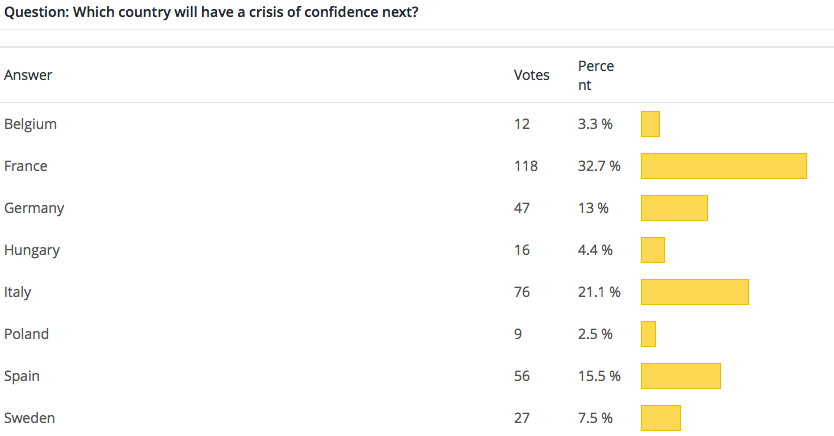
“By the way, your latest article ” World out of whack” was great. I believe the next crisis country will be Italy with their massive banking problems. The Euro is simply too strong for them and in the old days they were able to compete against Germany by constantly depreciating the Lira.
Best,
H.”
Excellent points on the historical situation with Germany and Italy, and pinpointing the currency aspect.
Not everyone agreed with Italy as it came in a close second to France, as you can see below from the poll I ran in the recent World Out Of Whack.
We’re actually dealing with two drifferent problems here – the EU and the currency. Let’s take a closer look at both.
The EU was originally designed to stop Europeans killing each other (something they’ve been doing for centuries) and to foster closer ties between European countries by eliminating barriers to trade. As the old adage goes, “When goods don’t flow, bullets do.” And this was at the core of the EU idea.
Giuseppe always loved BMWs, didn’t care for sauerkraut (I don’t blame him), and – while being infuriated with Hans who is as punctual as Big Ben – saw no reason not to make the buying of his BMW any easier.
Hans, on the other hand, still believed that all Italian woman were smoking hot, all Italian men were plumbers, and though he couldn’t understand how pasta could be eaten everyday without causing some sort of digestive problem, he welcomed the idea of shooting down to Puglia for a weekend’s sun – sans silly visa requirements.
So why not allow Hans and Giuseppe to manage all this with less friction?
Increasingly though, the EU has become a barrier to trade rather than an enabler. Today there are restrictions and laws governing how bendy a banana must be. Not bendy enough and it doesn’t meet regulation. Cucumbers can’t be too bendy, on the other hand. Not straight enough and they too are in the tip.
Then there is the famous case of the EU directive stating that water does in fact NOT hydrate you. Retailers of water were banned from suggesting water would in fact hydrate you.
Prunes are not laxatives (contrary to …read more
Source: Answer This!
Mega Millions jackpot climbs to $449 million

There were no jackpot winners in Friday’s Mega Millions drawing, pushing the payout to $449 million. …read more
Source: Mega Millions jackpot climbs to $449 million
Welcome to Esh Carmel Blog.
Need A Job ?
Job Hunting ?
Need Help ?
CLICK HERE :
Job Hunters : How to Stand Out from the Crowd and Tap Into the Hidden Job Market
-
PLEASE NOTE: As with any precautionary warning, ALWAYS consult with your physician before taking any action in regards to your health.
This site does not provide medical or any other health care or fitness advice, diagnosis, or treatment. The site and its services are for informational purposes only and are not a substitute for professional medical or health advice, examination, diagnosis, or treatment. Always seek the advice of your physician or other qualified health professional before starting any new treatment, making any changes to existing treatment, or altering in any way your current exercise or diet regimen. Do not delay seeking or disregard medical advice based on information on this site While we try to keep the information as accurate as possible, we disclaim any implied warranty or representation about its accuracy or completeness. The reader assumes full responsibility for using the information on this site. This site is neither responsible nor liable for any claim, loss or damage resulting from the use of information on this site. This site is intended for use by adults only. Minors should use this site only with the involvement of a parent or guardian.
How to Get a Great Job in 90 Days or Less


