Best Appetite Control Supplements on Amazon


Work at Home - Generate Income from Anywhere


35 Home Based Business Startups for under $500 - Be Your Own Boss


Garcinia Cambogia with 95% HCA Weight Loss Supplement - Best Fast Acting Fat Burner and Natural Carb Blocker Diet Pills - Pure Garcinia Extract


Archive for the ‘Uncategorized’ Category

Failure of the War on Cash

Find The Lowest Price HERE


By Sprott Money

Failure of the War on Cash - Jeff Thomas

Some years ago, when I suspected there would be a War on Cash at some point, everything in the behaviour of the central banks pointed to the idea – it fit exactly into their own informed, yet unrealistic pattern of logic. I therefore decided that it would be a likely development and would take place at a time when they had tried everything else and had run out of other ideas. As to a date when this might happen … I had no idea.

When several countries had begun to limit the amount of money that a depositor could take out of a bank, I decided that the first shots in the War on Cash had been fired and began to publish my prognostications as to what shape it would take. First, there were the benefits to the bank (the elimination of cash transactions, which would assure that virtually all monetary transactions, large and small, would have to be passed through banks, allowing them to effectively “own” all deposits, charge for every transaction and even refuse transactions.) The governments would also benefit. In approving the banks’ monopoly on monetary transactions, they’d benefit primarily through the new ability to tax people by direct debit, ending any remnant of voluntary payment of taxation.

What I didn’t anticipate at that time was that, within a few months, the War on Cash would be escalated quickly – more quickly than was safe for them to do, as it could alarm depositors. (As in the old analogy of boiling a frog, it’s always best to turn up the heat slowly, to lull the victim into complacency, as he’s being done in.)

This indicated to me that the central banks had decided that they’d already waited too late and had better hurry up the programme to assure that it was in place before a currency crisis could heat up.

Since then, someone came up with an excellent name for the phenomenon, “the War on Cash,” one that succinctly describes the plan in a nefarious way, as it deserves to be described. Today, anyone who is paying attention is aware of the War on Cash and what it might do to him. As each new salvo by the banks and governments is uncovered, attentive observers are publishing such developments on the internet.

However, there’s a further facet to the War on Cash that no one (to my knowledge) has yet addressed. The war is still new, and those who will be attacked are understandably still scrambling for their muskets and hurrying to the ramparts. (Musing on how a war will play out usually comes later, as it’s winding down and a victor seems apparent. However, in my belief, it’s wise to examine what the landscape will look like after the war is over, as it can serve to inform us as to what battle tactics should be employed.)

…read more

Source: Failure of the War on Cash


100% Pure Garcinia Cambogia Extract – Appetite Suppressant – Carb Blocker Capsules – 2100 MG – 90 Caps

Looking for something special ? Find The Lowest Price HERE


28 Blank Pages: Washington’s Cover-Up Of The Saudi Role In The 9/11 Terrorist Attack Continues

Find The Lowest Price HERE


By Tyler Durden

In light of today’s 60 Minutes segment, according to which classified “28 pages” may shed light on Saudi ties to terrorism, here is a an article which was originally posted in the December 2015 edition of Future of Freedom. More to follow tomorrow.

28 Blank Pages: Washington’s Cover-Up Of The Saudi Role In The 9/11 Terrorist Attack Continues

Do Americans have the right to learn whether a foreign government helped finance the 9/11 attacks? A growing number of congressmen and senators are demanding that a 28-page portion of a 2002 congressional report finally be declassified. The Obama administration appears to be resisting, and the stakes are huge. What is contained in those pages could radically change Americans’ perspective on the war on terror.

The congressional Joint Inquiry Into Intelligence Community Activities Before and After the Terrorist Attacks of September 11, 2001, completed its investigation in December 2002. But the Bush administration stonewalled the release of the 838-page report until mid 2003 — after its invasion of Iraq was a fait accompli — and totally suppressed a key portion. Former U.S. Sen. Bob Graham (D-Fla.) chairman of the investigation, declared that “there is compelling evidence in the 28 pages that one or more foreign governments was involved in assisting some of the hijackers in their preparation for 9/11.” Graham later indicated that the Saudis were the guilty party. But disclosing Saudi links to 9/11 could have undermined efforts by some Bush administration officials to tie Iraqi leader Saddam Hussein to the 9/11 attacks.

Almost everyone has forgotten how hard the Bush administration fought to torpedo that report. In April 2003, controversy raged on Capitol Hill over the Bush administration’s continuing efforts to suppress almost all of the report by the Joint Intelligence Committee investigation. Some intelligence officials even insisted on “reclassifying” as secret some of the information that had already been discussed in public hearings, such as the FBI Phoenix Memo. On May 13, Senator Graham accused the Bush administration of engaging in a “cover-up” and said that the report from the congressional investigation “has not been released because it is, frankly, embarrassing … embarrassing as to what happened before September 11th, but maybe even more so the fact that the lessons of September 11th are not being applied today to reduce the vulnerability of the American people.” Sen. Trent Lott (R-Miss.) complained that intelligence agencies sought to totally censor the report: “The initial thing that came back was absolutely an insult, and it would be laughable if it wasn’t so insulting, because they redacted half of what we had. A lot of it was to redact a word that revealed nothing.”

When the report was finally released, Sen. Richard Shelby (R-Ala.) added an additional opinion in which he castigated “the FBI’s dismal recent history of disorganization and institutional incompetence in its national-security work.” The congressional report was far blunter than the subsequent 9/11 Commission. The congressional investigation concluded that the FBI’s “mixed record of attention contributed to the …read more

Source: 28 Blank Pages: Washington’s Cover-Up Of The Saudi Role In The 9/11 Terrorist Attack Continues


100% Pure Garcinia Cambogia Extract – Appetite Suppressant – Carb Blocker Capsules – 2100 MG – 90 Caps

Looking for something special ? Find The Lowest Price HERE


China CPI Misses, Drops Sequentially As PPI Declines For 49 Consecutive Months

Find The Lowest Price HERE


By Tyler Durden

There was some good and some bad news in tonight’s Chinese March inflation (and deflation in the case of PPI) data.

The good news, for those who believes that rising inflation is a positive economic outcome, was that Producer Prices declined “only” 4.3% Y/Y, or less than the -4.6% exoected, and better than the -4.9% drop last month. On a sequential basis, PPI rose by 0.5% on the back of various commodity input prices posting a modest increase in the past month on the back of China’s epic January loan injection.

However, putting that rebound in context, on an annual basis, Chinese gate inflation, or rather deflation, has now been negative for 49 consecutive months.

The not so good news, was in the CPI print, which rose 2.3% Y/Y, missing expectations, and in line with last month’s identical increase. This tied headline inflation at a 22 month high, even as non-food inflation rose a paltry 1% in March.

On a sequential basis, however, CPI dropped by 0.4% M/M, driven by a 0.1% decline in non-food inflation coupled with a much needed 1.8% drop in food inflation. As a reminder, in recent months Chinese food inflation has exploded driven by a 60% jump in pork prices which had risen to the point where the population was starting to grumble about the surging prices of this most popular protein in the mainland.

Still, on a Y/Y basis, food inflation rose once more, increasing 7.6% Y/Y and remains the only stable component of inflation, hardly the “diet” for a stable, growing economy, in which consumers are forced to spend their discretionary income on staples instead of pushing up broader, core prices.

The best news, however, since China’s inflation appears to have once again peaked, is that this means the media will be flooded with expectations of more stimulus from the PBOC in the form of either RRR or interest rate cuts, which in turn pushed the Shanghai Composite more than 1% higher and back over 3000. Then again, whether the PBOC agrees with such an assessment, one which by definition will further weaken the Yuan, remains to be seen.

…read more

Source: China CPI Misses, Drops Sequentially As PPI Declines For 49 Consecutive Months


100% Pure Garcinia Cambogia Extract – Appetite Suppressant – Carb Blocker Capsules – 2100 MG – 90 Caps

Looking for something special ? Find The Lowest Price HERE


Economic Collapse Is Erupting All Over The Planet As Global Leaders Begin To Panic

Find The Lowest Price HERE


By Michael Snyder

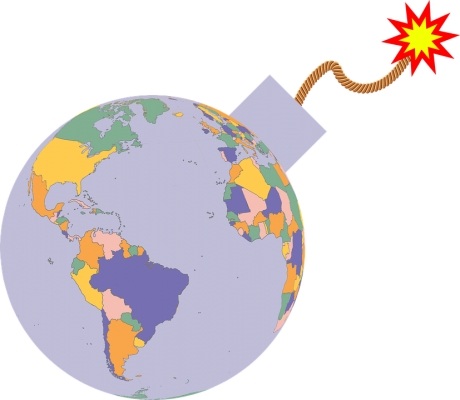
Earth Ready To Explode - Public Domain

Mainstream news outlets are already starting to use the phrase “economic collapse” to describe what is going on in some areas of our world right now.  For many Americans this may seem a bit strange, but the truth is that the worldwide economic slowdown that began during the second half of last year is starting to get a lot worse.  In this article, we are going to examine evidence of this from South America, Europe, Asia and North America.  Once we are done, it should be obvious that there is absolutely no reason to be optimistic about the direction of the global economy right now.  The warnings of so many prominent experts are now becoming a reality, and what we have witnessed so far are just the early chapters of a crushing economic crisis that will affect every man, woman and child in the entire world.

Let’s start with Brazil.  It has the 7th largest economy on the entire planet, and it is already enduring its worst recession in 25 years.  In fact, at the end of last year Goldman Sachs said that what was going on down there was actually a “depression“.

But now the crisis in Brazil has escalated significantly.

I want to share with you an excerpt from a recent article entitled “Brazil: Economic collapse worse than feared“.  I know, that title sounds like it comes directly from The Economic Collapse Blog, but I didn’t write it.

It actually comes from CNN

Amid political chaos, Brazil’s economic collapse is worse than its government once believed.

In the midst of rising calls to impeach President Dilma Rousseff, Brazil’s central bank announced Thursday that it now expects the country’s economy to shrink 3.5% this year.

That’s worse than the central bank’s previous estimate for a 1.9% contraction. The darker forecast matches what the International Monetary Fund projected for Brazil — Latin America’s largest country — and what many independent economists have suspected.

It is one thing for Michael Snyder to tell you that Brazil is in the midst of “economic collapse”, but it is another thing entirely for CNN to say it.

And of course I have been warning about the crisis down in Brazil for quite some time now.  For much more on this, please see my previous article entitled “The Economic Collapse Of South America Is Well Underway“.

Meanwhile, things are actually much worse in Venezuela than they are in Brazil.  Food and basic supplies are in short supply, the inflation rate has hit 720 percent, and crime is completely out of control.

The following is from an article in the Independent entitled “Venezuela is on the brink of complete economic collapse“…

The only question now is whether Venezuela’s government or economy will completely collapse first.

The key word there is “completely.” Both are well into their death throes. Indeed, Venezuela’s ruling party just lost congressional elections that gave the opposition a veto-proof majority, and it’s hard to see that getting any better for them any time soon — or ever.

Incumbents, after all, don’t tend …read more

Source: Economic Collapse Is Erupting All Over The Planet As Global Leaders Begin To Panic


100% Pure Garcinia Cambogia Extract – Appetite Suppressant – Carb Blocker Capsules – 2100 MG – 90 Caps

Looking for something special ? Find The Lowest Price HERE


Japan Says G-20 Accord Barring FX Devaluations Does Not "Rule Out Intervention" In The Yen

Find The Lowest Price HERE


By Tyler Durden

One of the biggest unconfirmed secrets of recent market action was whether or not there was a Shanghai Accord in February, in which the G20 and central bankers decided to push the dollar lower to benefit China at the expense of Japan and Europe, both of whom have suffered substantially in recent weeks as a result of their own currencies surging, pushing local stock markets lower (and sending European banks sliding).

Earlier today, Japan’s government spokesman Suga came as close as possible to admitting that there was in fact a tacit “Shanghai Accord” agreement when he said that the Group of 20’s agreement to avoid competitive currency devaluation “does not mean Japan cannot intervene in response to one-sided currency moves.”

It got better: in an interview with Reuters Suga added that Japanese Prime Minister Shinzo Abe’s comment to the Wall Street Journal last week that countries should avoid “arbitrary intervention,” was misunderstood and does not rule out intervention for Japan, Suga said.

And yet it did rule out intervention until now? He clarified. “What the G20 is talking about is arbitrary intervention, which is different from responding to a one-sided move,” Suga told Reuters in an interview on Saturday.

So arbitrary is not really arbitrary if as a result of other arbitrary devaluations the market decides to focus on Japan… which sound oddly like Obama defending Hillary and explaining how confidential is not confidential.

As Reuters notes, some traders have said Japan cannot sell its own currency now, because the G20 warned countries in February to refrain from competitive devaluation. Suga, who coordinates other ministers in Abe’s cabinet, rejected this idea outright and said Abe’s remarks about arbitrary intervention in a Wall Street Journal interview last week were misunderstood.

“The prime minister’s comments were based on the G20 understanding that long-term manipulation of currencies is undesirable.”

As a reminder, the last time Japanese authorities intervened directly in the market was in 2011, when Tokyo got an explicit G7 consent to stem a yen spike driven by speculation that a devastating earthquake and nuclear disaster in March would force Japanese insurers to repatriate funds to pay claims.

What is fascinating is how weak even Japan’s attempts at verbal intervention have become.

The attempts at posturing continued:

Suga also rejected the argument that the adoption of negative rates was a sign the BOJ’s attempts to meet its 2-percent price target had reached a limit.

Abe is meeting foreign economists to prepare to host a summit of G7 finance ministers and central bank governors in May, where he will urge other countries to coordinate policies to accelerate global growth.

The prime minister strongly believes G7 should lead the global economy with sustainable growth,” Suga said.

At this point Japan has become such a joke in trader circles, the nickname which we penned for Kuroda aka “Peter Panic”, appears to have stuck.

…read more

Source: Japan Says G-20 Accord Barring FX Devaluations Does Not "Rule Out Intervention" In The Yen


100% Pure Garcinia Cambogia Extract – Appetite Suppressant – Carb Blocker Capsules – 2100 MG – 90 Caps

Looking for something special ? Find The Lowest Price HERE


This Vancouver Home Just Sold For More Than $1 Million Above The Asking Price

Find The Lowest Price HERE


By Tyler Durden

Not a day passes without the Vancouver real estate market succeeding to amaze us all over again.

Just over a month ago we were amazed to learn that, in confirmation of the local buying frenzy, the Vancouver home shown on the photo below

According to a recent report by Knight Frank, prime residential property prices in Vancouver increased by 25% in 2015 “due to lack of supply, foreign demand and weaker Canadian dollar.” But mostly foreign demand as Chinese buyers scramble to launder their money in this Canadian city.

Vancouver’s soaring home prices posted nearly double the growth rate of the next few residential markets of Syndey (14.8% Y/Y), Shanghai (14.1%), Istanbul (13.0%) and Munich (12.0%).

And while there has been some speculation the government may crackdown on this runaway home price inflation, this has yet to happen. In the meantime, the horror stories of Vancouver’s houing market persist.

According to the National Post, another west side Vancouver home has sold for more than $1 million above the asking price. The Dunbar area bungalow was listed for $3.188 million and sold earlier this week for $4.19 million.

SunThis Dunbar area house sold for $1 million over the asking price this week.

This is the second time in just one month when a Vancouver home sells more than $1 million above asking. Just over a month ago, a Point Grey home with a view sold for $1.172 million more than the asking price. The sale price for the house on Bellevue Drive was more than $9 million and the new owner planned to rent it out then tear it down and rebuild in a couple of years, according to the realtor. The house had not been updated.

SunThe house has a new roof, updated bathrooms and a gourmet kitchen.

But the 71-year-old Dunbar house has been fully renovated, according to the MLS listing. It sits on a 44 by 122-foot lot and has a view from the back of the North Shore mountains. The house has a new roof, updated bathrooms and a gourmet kitchen as well as a one-bedroom basement suite.

“Perfect for families,” says the listing. Or, “hold and build.”

SunThe bungalow was listed for $3.188 million and sold for $4.19 million

University of B.C. real estate professor Tsur Somerville said the Dunbar home may have been listed low. “That is one third more than the asking price,” he said. “It looks a whole lot like a realtor playing games.”

That or the panic buying frenzy is getting bigger by the day.

Getting the right listing price for a property in Metro Vancouver’s overheated market is difficult, Somerville acknowledged.

“Because prices are going up so rapidly, so out of control, it’s hard to know what the price is,” he said. “The rate of price increases is reaching hysteria levels. It’s not sustainable.”

This is what is …read more

Source: This Vancouver Home Just Sold For More Than $1 Million Above The Asking Price


100% Pure Garcinia Cambogia Extract – Appetite Suppressant – Carb Blocker Capsules – 2100 MG – 90 Caps

Looking for something special ? Find The Lowest Price HERE


Guest Post: The U.S. Dollar – Return Of The King?

Find The Lowest Price HERE


By Tyler Durden

Atlanta Fed GDPNow

Submitted by $hane Obata

USD: Return Of The King

Falling oil prices, China growth fears, submerging markets, Brexit and Italian banks. All of those risks have one thing in common: They have not derailed the US economy. Despite concerns about a recession, it continues to grow at a steady pace. According to the Atlanta Fed, real GDP is expected to grow by 0.7% in Q1’16. That is not a great number; however, the series is extremely volatile.

sources: Bloomberg, @Not_Jim_Cramer

It would not be surprising to see growth rebound to 2% or more in the coming quarters.

Global investors are counting on the US because of lackluster growth elsewhere. Europe is doing fine; however, deflation remains a concern and bank credit growth is turning down. Japan continues to fall in and out of recession. In the emerging world, the BRICs are crumbling. Brazil & Russia are suffering due to falling commodity prices while China continues to decelerate. Going forward, rate differentials, relative economic strength and divergent monetary policies should provide support for the USD.

Sentiment & Positioning

With all that said, as of Mar29’16, the net speculative long position in the USD was 7% of open interest, the lowest it has been since Q2’14. This indicates that speculators are the least bullish they have been in nearly two years.

USD Specs

The US Dollar Index is sitting at 94.62, just above a critical support zone at 93-94. Meanwhile, the Trade-Weighted Dollar Index has pulled back ~3.4% from its high on Jan20’16. It is hard to tell that long USD is a consensus trade because investors have lost their conviction.

FX, Rates & Monetary Policy

USDCAD: Has fallen to 1.3011 from a high of 1.4692 on Jan20’16. This is a direct result of the relief rally in oil, which has risen to $36.79 from a low of $26.05 on Feb11’16. These moves have not been driven by improving fundamentals. Rather, they are mostly attributable to short covering.

CAD Specs
WTI Specs
via @Ole_S_Hansen

Rate differentials (see the following chart), relative economic strength and divergent monetary policies should support USDCAD in the near term. Also, it is unlikely that the bear market in commodities is over.

Rates Differentials
sources: Bloomberg, @sobata416

EURUSD & USDJPY: In Europe and Japan, easy monetary policy will be present for an extended period of time. The ECB and BOJ have made it clear that they will do “whatever it takes” to protect their countries from deflation. The ECB recently announced a set of new measures intended to support the Euro Zone. Equities have responded positively but the Euro has not. EURUSD is trading at 1.1389, up from a low of 1.0538 on Dec3’15. Japan is facing the same issue. Even though Japanese equities …read more

Source: Guest Post: The U.S. Dollar – Return Of The King?


100% Pure Garcinia Cambogia Extract – Appetite Suppressant – Carb Blocker Capsules – 2100 MG – 90 Caps

Looking for something special ? Find The Lowest Price HERE


Barclays Warns "Grexit" May Return This Summer While Tsipras "Demonizes" IMF

Find The Lowest Price HERE


By Tyler Durden

As we predicted last week when Wikileaks released an IMF transcript which suggested trubulent times may be ahead for Greece,

Diplomatic pandering aside, Tsipras rebuke undercut months of patient efforts by Tsipras himself and Finance Minister Euclid Tsakalotos to rebuild lenders’ trust following last summer’s turbulent events which culminated with a bank run, capital controls and a banking system that relies on the ECB for its daily existence.

As Reuters writes, it also shone a light on a complex, three-dimensional chess game the IMF is playing to try to make Greece accept painful reforms of pensions, taxation and bad loans while pressuring Germany and its allies to grant Athens substantial debt relief.

“Put simply, the IMF’s position is that the Greek economy is in worse shape than rosy EU forecasts suggest, and that a necessary relaxation of fiscal targets must be balanced by greater debt relief from euro zone lenders.”

Because apparently it is news to someone that while Europe was pretending it was helping Greece (when it was merely making sure none of the bond held by the ECB were defaulted on), Greece was pretending to reform.

Of course, since Greek reform in any measurable way is unachievable, there was the question of whether it makes sense to chop off some of the debt it can never repay, as a confirmation of what a great job Greece had been doing (or perhaps as impetus to force it to actually do something). By antagonizing the IMF – the only part of the Troika that was pushing for a haircut – that also is now off the table.

Germany, the biggest creditor, is the most reluctant about major debt restructuring. Its parliament insists on a continued IMF presence to enforce budget savings and minimize the need for stretching out loans and freezing interest payments.

“The bottom line is the debt will not be repaid in our lifetime,” said Jacob Kirkegaard, senior fellow at the Peterson Institute for International Economics in Washington.

Or ever.

“The IMF is gearing up for new clients in the emerging economies. That is not best done by being soft on Greece. They won’t go to the (IMF) board to approve participation in a third Greek bailout without something they think is tough and credible,” he said.

Brussels contends that both the economy and Greek compliance with the bailout programme are better than the IMF thinks, hence the first review should be concluded soon, allowing Athens to access the next 5 billion euros ($5.70 billion) of loans.

Reuters conclusion: “How the three-way tug-of-war between the IMF, Greece and Berlin will play out remains uncertain. The sequencing will be tricky, but no side seems to have an interest in walking away.”

Ironically, Greece finally has some true leverage over Germany as Merkel is more dependent now on Greece to act as Europe’s gatekeeper than she was during last year’s crisis over a …read more

Source: Barclays Warns "Grexit" May Return This Summer While Tsipras "Demonizes" IMF


100% Pure Garcinia Cambogia Extract – Appetite Suppressant – Carb Blocker Capsules – 2100 MG – 90 Caps

Looking for something special ? Find The Lowest Price HERE


Sunday without Trump for first time in 5 months

Find The Lowest Price HERE


For the first time since November, Donald Trump skipped the Sunday morning TV interview circuit.

…read more

Source: Sunday without Trump for first time in 5 months


100% Pure Garcinia Cambogia Extract – Appetite Suppressant – Carb Blocker Capsules – 2100 MG – 90 Caps

Looking for something special ? Find The Lowest Price HERE

Hazlitt, 1946: Inflation, Deflation, Confusion

Find The Lowest Price HERE


By Tyler Durden

By Mises.org, Originally printed in Newsweek on October 14th, 1946 as “Inflation, Deflation, Confusion.” Available in Business Tides: The Newsweek Era of Henry Hazlitt

Hazlitt, 1946: Inflation, Deflation, Confusion

In the last two years left-wingers have been fond of referring to private enterprise as a “boom-bust” economy; OPA officials have contended that only price fixing can prevent a repetition of the 1920–21 boom and collapse, and British statesmen have insisted that their new “democratic socialism” will work beautifully if only mercurial America doesn’t crack again and drag the rest of the world down with it. Small wonder that so many people now ask each other whether the recent slump in the stock market does not at last foreshadow this longpredicted business setback.

The question is not easy to answer, because the American economy has now become the football of political policies and counterpolicies that are not inherent in it but essentially external. These conflicting political policies are on the one hand those tending to create inflation, and on the other those tending to bring about disruption.

The inflationary forces are obvious, and until now have been controlling. Their primary causes are government deficit financing and other political policies that increase the volume of money and credit. Past inflationary forces are roughly measured by the increase in the national debt to $265,000,000,000 and of money and credit to more than three times the prewar volume. Potential future inflation is indicated by a still unbalanced budget in prospect (in spite of a balance in the first quarter of the current fiscal year), and by a policy of artificially low interest rates that promotes further increases in credit and further monetization of the public debt. As long as inflation raises prices faster than costs it stimulates business expansion, new ventures, and employment.

Against this, however, are equally powerful forces of disruption. The chief of them is price control, administered in a spirit hostile to profits and business. This has distorted relationships among profit margins and disrupted and unbalanced production. Builders find themselves with bricks and no doors, glass, or bathtubs. Automobiles wait on assembly lines for bumpers or batteries.

The profit squeeze from the top meets another from the bottom. Endless strikes, interrupting output, are followed by endless wage increases. To encourage or compel such wage increases the Administration ignores elementary property rights, seizes coal mines, and signs wage-boosting contracts itself. These wage increases must ultimately either raise costs to the point where many firms can no longer operate, or force up prices to levels that will cut off buying. In either case they will slow down production and force unemployment. Add to all this a basic hostility to business on the part of Washington agencies which is reflected in countless harassments.

Which of these two sets of forces will dominate the next six to twelve months—the inflationary or the depressive? That is impossible to say until we know the complexion of the next Congress …read more

Source: Hazlitt, 1946: Inflation, Deflation, Confusion


100% Pure Garcinia Cambogia Extract – Appetite Suppressant – Carb Blocker Capsules – 2100 MG – 90 Caps

Looking for something special ? Find The Lowest Price HERE


1 or more persons associated with this website : http://eshcarmel.org are participants in the Amazon Services LLC Associates Program, an affiliate advertising program designed to provide a means for blogs and websites to earn advertising fees by advertising and linking to amazon.com -- Compensation Disclaimer : Some of the links on this site will earn a commission when a person makes a purchase through our links. Every effort has been made to remain fair, accurate, and unbiased. Also see our FTC Disclaimer page.