
The Fed Has Whiffed Again – Massive Monetary Stimulus Has Not Helped Labor, Part 1
By Tyler Durden
Submitted by David Stockman via Contra Corner blog,
There is a deep irony embedded in the Fed’s savage assault on savers and its delusional doctrine of interest rate repression. While this actually results in monumental windfalls to speculators and the one percent, it’s all justified in the name of boosting the labor market and the wage bill.
So the chart in Jeff Snider’s nearby post is especially salient. It shows that all this money printing has been for naught. Notwithstanding the 9X eruption of the Fed’s balance sheet from $500 billion at the turn of the century to $4.5 trillion today, growth in the most basic measure of labor input—-total hours worked——has come to a grinding halt.
Compared to labor hours growth of nearly 3% annualized during the Reagan expansion of the 1980s and nearly 2% during the start-and-stop stagflationary economy of the 1970s, labor hours growth over the two boom-and-bust cycles since the Fed went full frontal on money printing in December 2000 has averaged just 0.15% per annum.
Stated in aggregate terms, during the 10-year expansion between 1980 and 1990, labor hours employed in the US economy grew by 23.5%. By contrast, during the last 15 years combined, labor hours employed have risen by only 2.3%.
Needless to say, this dismal outcome is not for want of potential labor supply. At the turn of the century, the civilian population aged 16 to 65 years was 177 million. That number has since grown to 205 million, meaning that the potential labor pool grew by 16% or nearly 7X faster than hours employed.
These figures also stick a fork in the Fed’s blind fixation on the U-3 unemployment rate and the nonfarm payroll numbers. Both are a relic of a half-century ago world of mines, factories, warehouses and retail shops based on a 40+ hour workweek on a year round basis.
By contrast, in today’s world of flexible just-in-time production, hours-based labor scheduling and gig-based employment patterns, there is really no such standardized labor unit as a “job”.
Likewise, the BLS conventions for counting as “employed” anyone on a payroll for even a few hours per week, and omitting from the labor force denominator tens of millions of potential workers not actively looking for jobs at the moment of the surveys, mean that its headline series are essentially noise.
Most certainly they do not validly measure economic “slack” in the labor force and therefore the degree to which the Keynesian bathtub of “potential GDP” is less than filled to the brim.
The silliness of the Fed’s targets is underscored by the graph below, which shows that the nonfarm economy is now employing only 15 billion more labor hours than it did in the year 2000. By contrast, assuming a standard work year of 2000 hours, the 28 million increase of the population 16-65 years old theoretically was capable of producing 56 billion more labor hours.
So only 27% of those potential hours were actually absorbed by the nonfarm economy.
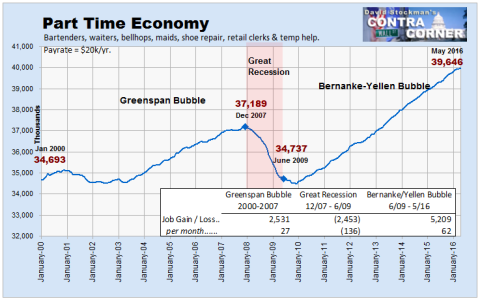
Likewise, as the jobs mix …read more
Source: The Fed Has Whiffed Again – Massive Monetary Stimulus Has Not Helped Labor, Part 1


