
The Fed’s 3rd Mandate & The Value Of Cash
By Tyler Durden
Submitted by Lance Roberts via RealInvestmentAdvice.com,
El-Erian – The Value Of Cash
My friend, Anora Mahmudova, recently wrote for MarketWatch about Mohamed El-Erian’s discussion on the importance of “cash” for investors.
“At a breakfast meeting with reporters on Monday, the former Pacific Investment Management Company chief executive said central bank asset purchases have successfully decoupled asset prices from fundamentals and distorted traditional correlations.
‘Investors cannot rely on correlations as a risk mitigator, making cash a very valuable thing to have.
It can give your portfolio resilience during stressful times, optionality—whether you use it for tactical or strategic purposes and flexibility to deploy it when necessary.’
Central banks are finding it harder and harder to repress volatility in financial markets, and any jolts, such as currency devaluation in China or political events, such as Brexit, result in wild swings in the markets.’
El-Erian also said years of unconventional monetary policy, including asset purchases, and a lack of fiscal stimulus are making developed economies less stable.”
Whenever El-Erian makes comments about the value of holding cash, there is generally a good bit of media lash-back about relating to the impacts of inflation and the inability to successfully navigate market cycles.
El-Erian’s comments are a valuation call, driven to excess by monetary interventions, on the financial markets suggesting that having capital invested will likely yield substantially lower or negative returns in the future. This is an extremely important concept in understanding the “real value of cash.”
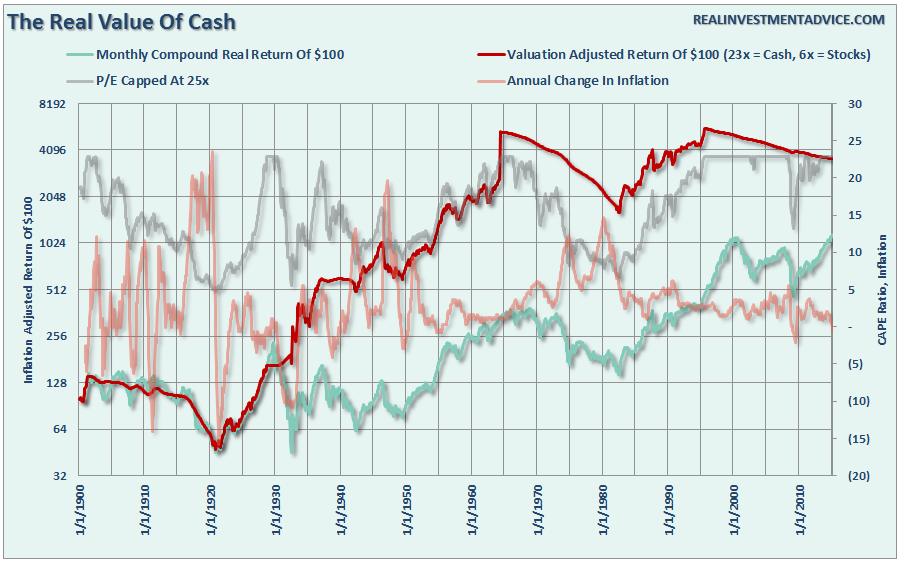
The chart below shows the inflation-adjusted return of $100 invested in the S&P 500 (using data provided by Dr. Robert Shiller). The chart also shows Dr. Shiller’s CAPE ratio. However, I have capped the CAPE ratio at 23x earnings which has historically been the peak of secular bull markets in the past. Lastly, I calculated a simple cash/stock switching model which buys stocks at a CAPE ratio of 6x or less and moves to cash at a ratio of 23x.
I have adjusted the value of holding cash for the annual inflation rate which is why during the sharp rise in inflation in the 1970’s there is a downward slope in the value of cash. However, while the value of cash is adjusted for purchasing power in terms of acquiring goods or services in the future, the impact of inflation on cash as an asset with respect to reinvestment may be different since asset prices are negatively impacted by spiking inflation. In such an event, cash gains purchasing power parity in the future if assets prices fall more than inflation rises.
While no individual could effectively manage money this way, the importance of “cash” as an asset class is revealed. While the cash did lose relative purchasing power, due to inflation, the benefits of having capital to invest at low valuations produced substantial outperformance over waiting for previously destroyed investment capital to recover.
While we can debate over methodologies, allocations, etc., the point here is that “time frames” are crucial in the discussion of cash as an asset class. If an individual …read more
Source: The Fed’s 3rd Mandate & The Value Of Cash


