
Why The Collapse Of The U.S. Economic & FInancial System Has Accelerated
By SRSrocco

By the SRSrocco Report,
The collapse of the U.S. economic and financial system accelerated this year, thus pushing the country closer to a third-world status. Most Americans are unaware of the dire consequences facing the nation, so they continue to believe business as usual will continue indefinitely.
Unfortunately, lousy reporting by the Mainstream media along with the public’s denial and delusional thinking is a recipe for disaster for most Americans over the next several years.
The U.S. economy is being propped up by a great deal of monetary printing, Fed stock and bond purchases and extreme leverage in all areas of the market. While these policies have given the “ILLUSION” of continued prosperity, or at best a sustainable slow growing economy, the debt now in the system is unsustainable.
Still to this day, most investors (including precious metals investors) do not understand the real reason for the massive increase in U.S. Federal debt. They believe the debt was either increased to enslave Americans or to fund continued economic growth. While the second reason is more accurate, they still fail to understand the “ROOT CAUSE” of the debt increase.
The Massive Increase In U.S. Debt Tied To Falling U.S. Oil Production & Rising Oil Prices
This chart puts the huge increase in total U.S. debt in perspective:
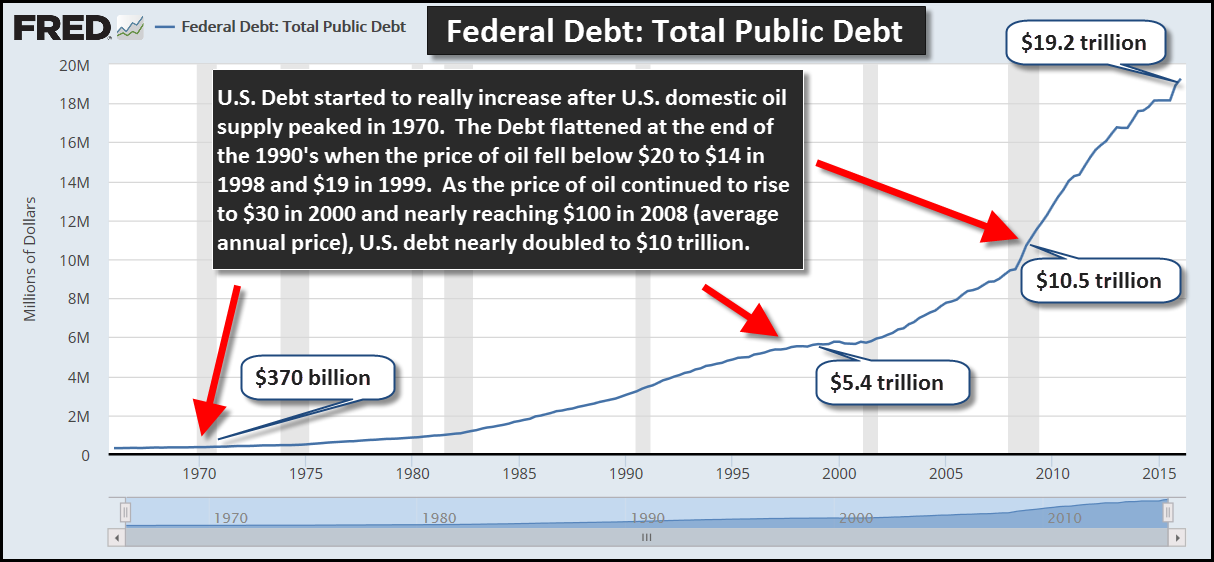
The annual increase in U.S. debt was very small up until the 1970’s. This was due to the peak of cheap U.S. domestic oil production. U.S. oil production peaked in 1970 at about 10 million barrels per day (mbd). That year, total U.S. debt was $370 billion. That’s hilarious, because the annual deficits today are larger than the entire U.S. debt in 1970.
As the oil price increased in the 1980’s and as U.S. oil production declined, total U.S. debt continued to increase. However, in the late 1990’s, the U.S. debt leveled off. This was due to the price of oil declining below $20, reaching $14 in 1998 and $19 in 1999. In 1999, U.S. debt had increased to $5.4 trillion.
Then as the price of oil increased from $30 in 2000 to nearly $100 in 2008, total U.S. debt nearly doubled to $10.5 trillion. In addition, U.S. domestic oil production declined nearly 4 million barrels per day from 1985 to 2008. This also had a negative impact on U.S. debt levels.
————————————
IF YOU ARE PAYING MORE THAN 30 BASIS POINTS A YEAR TO STORE PRECIOUS METALS, YOU ARE PAYING TOO MUCH!!! If you haven’t checked out our new new PRECIOUS METALS INVESTING section or our new LOWEST COST PRECIOUS METALS STORAGE page on our SRSrocco Report site, I highly recommend you do.
———————————–
While it’s true that the cost of energy is only a small part of U.S. GDP, its impact is multiplied when the U.S. economy and government try to provide the same standard of living as it did prior …read more
Source: Why The Collapse Of The U.S. Economic & FInancial System Has Accelerated


